Loading...
Subscribe to Our Newsletter
Get the latest updates delivered straight to your inbox.

The ultimate L&D solution for upskilling your workforce.


© 2026 SkillUp MENA, Inc. All rights reserved
Subscribe to Our Newsletter
Get the latest updates delivered straight to your inbox.
The ultimate L&D solution for upskilling your workforce.
© 2026 SkillUp MENA, Inc. All rights reserved


 Share :


Designing a Virtual Skills Review Clinic in OmanThree weeks after a training program on writing work order close-out notes, a technician at a site near Sohar finishes a repair and opens the form. He remembers the session, but this fault does not look like any of the examples. He writes what he can; the note goes to the planning office, and it comes back the next day marked incomplete. The trainer has moved on to another program, and the planner who rejected the note has no time to explain.
This is the point where much training fades: the first real attempts at work, with no one to review them. Another refresher course rarely helps, because the questions are specific to each person’s own work. What helps is a short, scheduled review of a real attempt by someone who knows the standard.
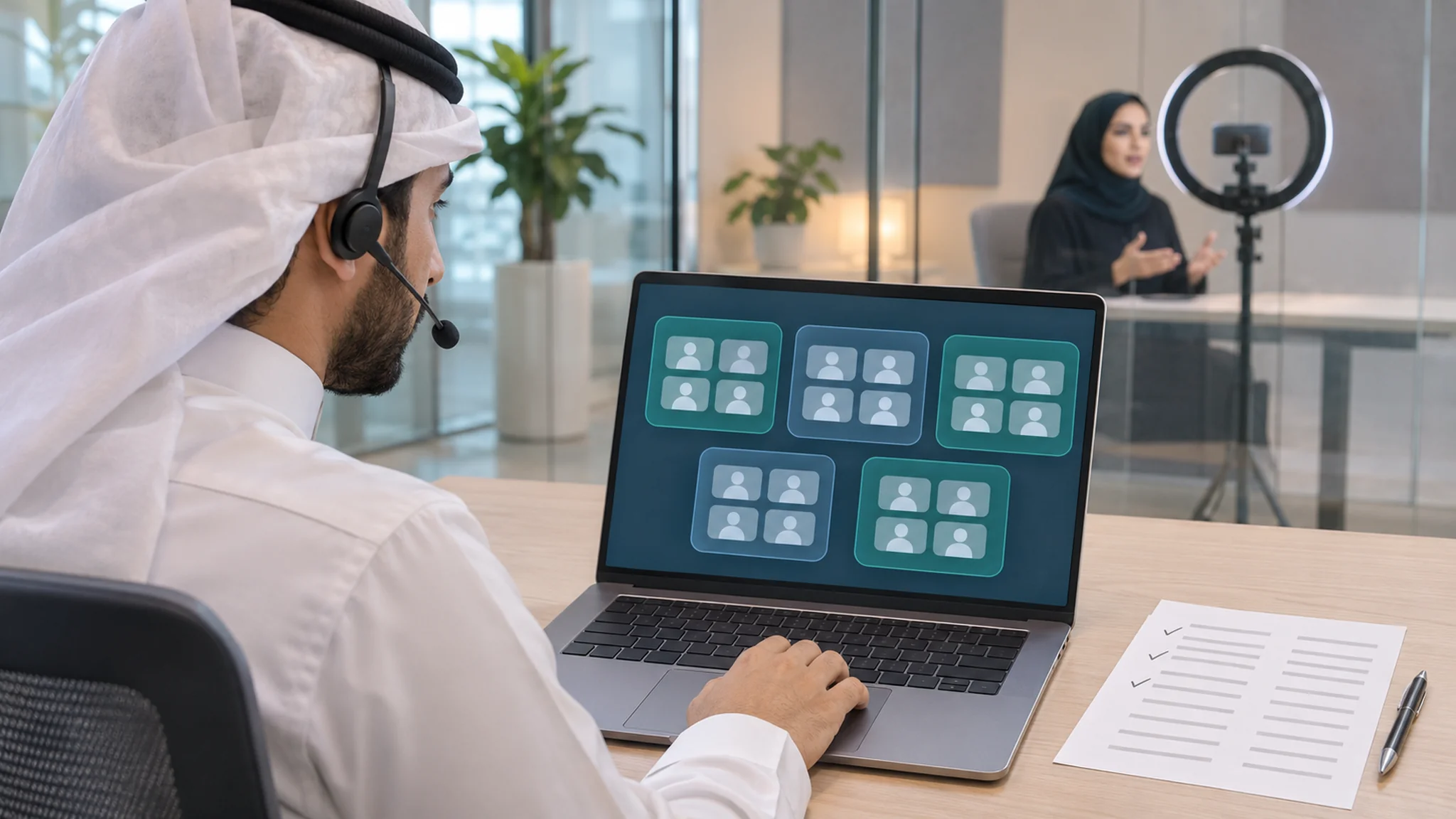
This article shows training teams and facilitators in Oman how to design a virtual skills review clinic using VILT, or virtual instructor-led training: each learner submits one real case before the clinic, an expert reviews that attempt in a short live slot, and patterns across cases go back into job aids and content.
What a VILT Skills Review Clinic IsA clinic is a short, booked VILT slot, usually 15 to 25 minutes, in which an expert reviews one piece of real work that the learner has submitted in advance. It is not a refresher lecture, an open question-and-answer hour, or a performance appraisal. Its only purpose is to help the learner apply what the training taught to their own work. Unlike a group VILT session, the agenda is set by what the learner sends, not by the trainer’s slides.
The clinic belongs to the period after training, which is where evaluation models put the real test. The Kirkpatrick Model defines Level 3 as the degree to which people perform the critical behaviors in their work environment, and describes an accountability and support package, such as manager check-ins, observations, and job aids, as crucial to success at that level. It also warns that measuring behavior cannot wait until 90 days after learning. A VILT clinic is one practical form of that support: an observation of real work, scheduled while the training is still fresh.
It also differs from practice inside the training itself. During a session, learners attempt cases the trainer designed; for that approach, see our guide to practice attempts inside a VILT session. In a clinic, the case comes from the learner’s own job.
Step 1: Define What Learners SubmitThe case submission is the core of a VILT clinic, so make it simple and specific. Ask each learner to send, two working days before their slot:
Real cases are messy, which is the point. Ask for work completed in the last two weeks, so the learner still remembers the decisions behind it. If a learner has no suitable case yet, offer a short practice case from the training instead, but treat this as the exception.
Step 2: Prepare the Expert ReviewThe expert reviews each submission before the clinic, using the same standard the training used. Without that preparation, the VILT slot turns into the expert reading the document aloud.
The expert does not have to be the original trainer. A senior practitioner who knows the standard and the real work, such as a planning engineer or an experienced supervisor, is often better placed. Brief them on the clinic format and the three points below, and check that they are comfortable sharing a document on screen and marking it up during a VILT call.
How the review is worded matters as much as what it says. In a review of research on formative feedback, Valerie Shute defines it as information communicated to the learner to modify thinking or behavior in order to improve learning, and reports guidance that such feedback should be non-evaluative, supportive, timely, and specific. For a VILT clinic, that translates into three prepared points:
Leave grades out. A VILT clinic that scores people becomes an assessment, and learners stop sending their difficult cases.
Step 3: Run the VILT Clinic SlotA 20-minute VILT slot can follow a simple rhythm:
The live revision is what turns advice into a second attempt. Even a rewritten sentence or a corrected field shows whether the point landed. Share the document on screen so both people see the same lines, and keep cameras optional; in a VILT clinic, the work is the focus, not the faces.
A small-group VILT clinic is a useful variant: three learners with similar cases book a 45-minute slot, and the expert reviews each case while the others watch and ask questions. Learners see three versions of the same problem, and the expert’s time goes further. Use it only when learners agree to share their work with colleagues.
Scheduling a VILT Clinic SeriesPlan VILT clinics as part of the program, not as an afterthought. Two rounds often work well, for example, two and five weeks after training, with a booking sheet where learners choose a slot. Budget the expert’s time honestly: twelve learners with 20-minute slots and preparation time take more than a working day per round.
Agree the managers’ role in advance. Managers approve the time for each VILT slot, encourage learners to bring a real case, and receive the aggregated themes, not individual clinic notes. If an external provider delivers the training at your sites, include the clinic rounds and the expert’s availability in the delivery agreement; our guide to what to request before a provider delivers training at Omani sites covers that agreement.
Using What VILT Clinics RevealAfter each round of VILT clinics, the expert and the training team review the clinic records together. Patterns matter more than individual cases:
Where the training includes eLearning modules, clinic findings are a direct input to revisions; see our guide to updating eLearning when work procedures change in Oman.
A Hypothetical Example: Close-Out Notes at an Industrial Services CompanyThe following example is hypothetical and is included only to illustrate the design.
An industrial services company with sites in Sohar and Duqm trains 12 maintenance technicians to write clearer work order close-out notes: the fault found, the action taken, parts used, and any follow-up needed. Two and five weeks later, it runs VILT clinic rounds with a senior planning engineer, in 20-minute slots.
Each technician books a VILT slot through a shared sheet and submits one recent close-out note with asset and customer identifiers removed. In the first round, the engineer sees the same pattern in seven notes: the action is clear, but the follow-up field is empty even when a part was only temporarily fixed. In each slot, the technician rewrites the follow-up line live.
The training team turns the pattern into a short job aid with three examples of good follow-up lines, and the planning office adds a prompt to the form. In the second round, the clinics move on to harder cases, such as faults with more than one cause.
The clinic does not replace site supervision or the sign-off process for maintenance work; it improves the quality of the written record that supervisors and planners rely on.
Practical Points for VILT Clinics in OmanLanguage and TermsIf learners write work records in English but discuss them in Arabic, let the VILT clinic conversation follow the language they think in, and keep form fields and technical terms exactly as written. The expert’s three points can be sent afterwards in the language the learner prefers.
Sites, Shifts and ConnectionsTechnicians and field staff may work shifts at remote sites. Offer VILT slots at shift changes, keep each one short, and allow joining by phone, with the submitted document sent in advance so that the discussion still works without screen sharing.
Case DataReal cases can contain customer names, asset numbers, or personal details. Agree what must be removed before submission, keep clinic records within the training team, and handle them under your organization’s data policies.
SummaryA virtual skills review clinic fills the gap between training and confident work: each learner submits a real case, an expert prepares a specific, non-evaluative review, and a short VILT slot ends with a live revision and one agreed next step.
Start with one program and one VILT clinic round two weeks after training. Keep slots short, protect the expert’s preparation time, and use the patterns across cases to improve job aids, forms, and content. Over time, VILT clinics become the follow-up that makes training stick.
Click here. If you would like to plan a VILT review clinic to follow a training program in Oman, the SkillUp MENA team can discuss your requirements with you.