Loading...
Subscribe to Our Newsletter
Get the latest updates delivered straight to your inbox.

The ultimate L&D solution for upskilling your workforce.


© 2026 SkillUp MENA, Inc. All rights reserved
Subscribe to Our Newsletter
Get the latest updates delivered straight to your inbox.
The ultimate L&D solution for upskilling your workforce.
© 2026 SkillUp MENA, Inc. All rights reserved

 Share :


AR or VR for Employee Training in Saudi Arabia? Start with the TaskA plant manager in Jubail returns from a technology exhibition convinced that his technicians need VR training. In the same week, the maintenance superintendent asks for something else: step-by-step guidance that appears on the equipment itself while technicians work. Both requests are described as immersive learning, both promise safer and faster results, and the training team is asked to shortlist suppliers before anyone has named the task the technology is meant to improve.
That is the wrong place to start. Augmented reality (AR) and virtual reality (VR) solve different training problems, need different equipment, and lead to different kinds of assessment. Comparing headsets and demonstrations first usually produces an impressive pilot that few people still use a year later, whether the pilot was AR guidance or VR training.
This article gives innovation, training, and operations teams in Saudi organizations a task-first way to decide between AR support and VR training, or to conclude that a simpler format will do. It explains what each technology does, the questions that point to one or the other, what each asks of your equipment and setting, and how assessment changes.
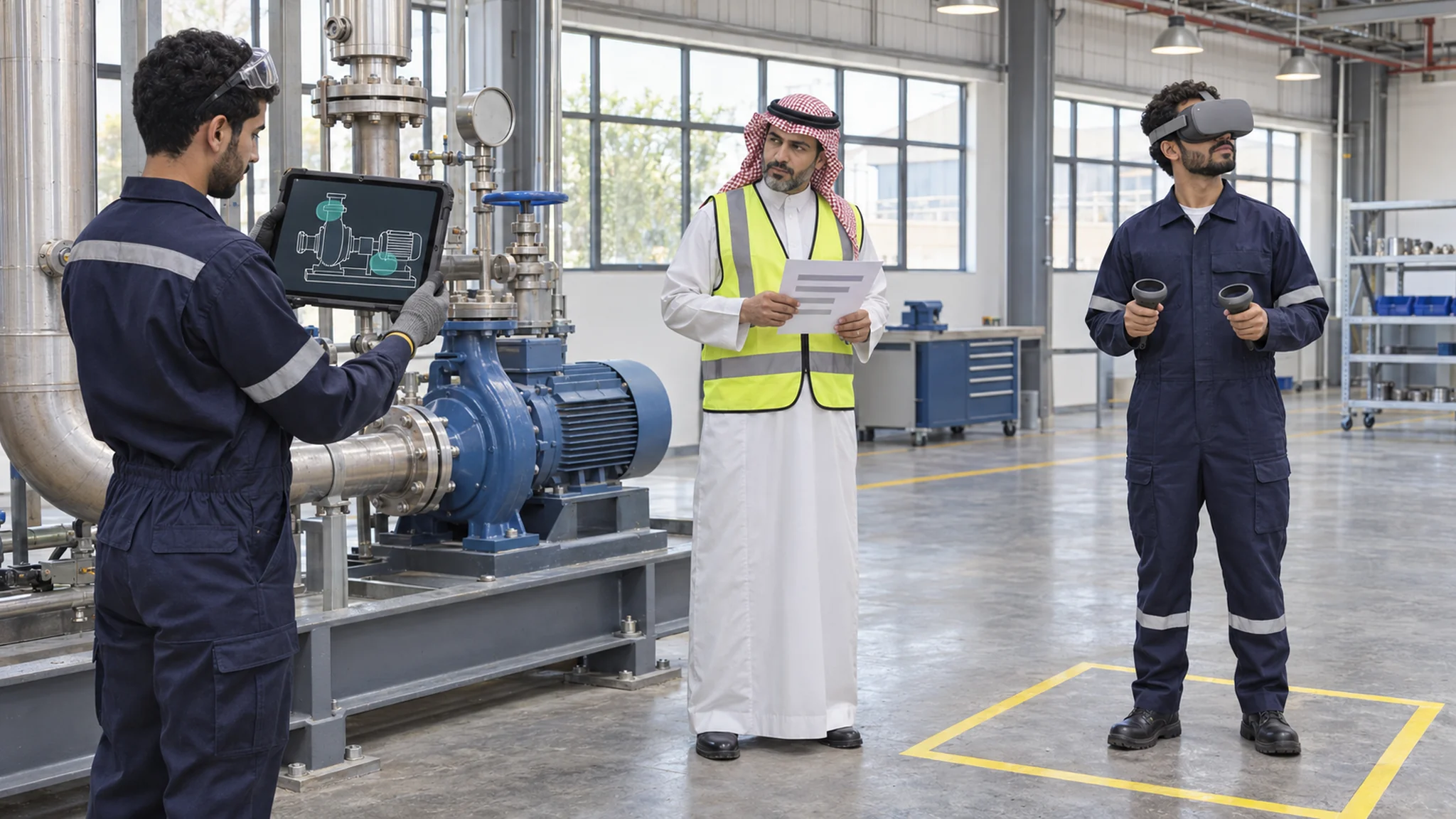
AR Support and VR Training Solve Different ProblemsThe U.S. Government Accountability Office’s spotlight on extended reality technologies draws the line clearly. AR overlays digital content onto the real environment, using smartphones, tablets or AR glasses. VR completely obscures the real world and immerses users in a digital environment through head-mounted displays. The spotlight also notes that these technologies are already used to train workers before they operate complex systems.
For a training decision, that difference becomes two separate questions:
Neither is always better than the other, and neither is automatically better than a good demonstration, a coached shift or a well-designed scenario on a laptop. VR training earns its place only where the simulated environment adds something the real one cannot. AR earns its place only where guidance at the point of work changes what employees actually do.
Five Task Questions Before Choosing AR or VR TrainingWrite down one task, in one role, with one result a supervisor can observe. Then work through these questions with the people who supervise that task, not only with the technology team.
1. Where Does the Difficulty Sit?If employees know what to do but forget steps, sequences, or the position of parts on real equipment, the problem is support at the point of work, which points toward AR or a simple job aid. If they struggle to recognize a situation, or to decide what to do when it happens, the problem is judgment, which points toward VR training or another form of scenario practice.
2. Can It Be Practiced Safely on the Real Thing?Routine procedures on equipment that can be taken out of service for practice rarely need VR training. Situations that are dangerous, disruptive, or costly to recreate, such as an abnormal process condition or a congested loading area, are where VR training in a simulated environment can justify its cost. The GAO spotlight lists the teaching of costly or dangerous procedures among the possible benefits of these technologies, and it frames this as a possibility, not a guarantee.
3. How Often Does the Situation Occur?A rare event gives employees few chances to practice on the job, so repeated VR training sessions can fill that gap. A frequent procedure already offers plenty of real practice. What employees may need instead is guidance during their first weeks, or when several equipment models differ in small but important ways, which favors AR or a printed aid.
4. Is It a Skill Headsets Have Shown Value For?In a review of 21 experimental studies of head-mounted displays in education and training, Jensen and Konradsen found them useful for three kinds of skill:
remembering and understanding spatial and visual information; psychomotor skills tied to head movement, such as visual scanning and observation; and controlling one’s emotional response to stressful or difficult situations. Outside these, the headsets showed no advantage over less immersive technology or traditional instruction, and in some cases proved counterproductive because of cybersickness or because the immersive experience distracted from the learning task.
The authors also rated the quality of the studies as below average. Read their findings as a guide for VR training decisions, not as a promise that any particular program will work.
5. Would a Simpler Format Close the Gap?If a short demonstration video, a decision scenario on a laptop, or a coached shift would solve the problem, start there. AR content and VR training both take time to design, review, and maintain, so each should solve a problem that simpler formats cannot.
What AR and VR Training Ask of Your Equipment and SettingAR guidance must match the exact equipment, model, and version in front of the employee. That requires a way to identify the asset, a named owner who updates the content whenever equipment, parts, or procedures change, and devices that work in real site conditions: heat, gloves, noise, glare, and patchy connectivity. Our article on AR content for equipment inspection training in Saudi facilities looks at this layer in more detail.
VR Training: Space, Time and ComfortVR training needs headsets, a cleared space, charging and storage, scheduled sessions, and usually a facilitator who launches the scenario and leads the debrief.
Comfort needs planning from the first VR training pilot. The GAO spotlight notes that some users experience motion sickness and disorientation in immersive environments, and a systematic review and meta-analysis of VR sickness in head-mounted displays reported that symptom profiles were influenced by visual stimulation, locomotion, and exposure time. Its authors conclude that careful selection of content can reduce the risk.
In practice, keep each VR training scenario short, avoid artificial movement through the environment unless the task depends on it, let employees stop at any time without penalty, and offer an equivalent non-immersive route for anyone who cannot or prefers not to use a headset.
Both: Language, Review and DataWhether you choose AR content or VR training, a specialist who owns the task should review it before release. Scenario text, voice prompts and labels should use the Arabic and English terms employees actually hear on site. Check what any AR or VR training application records about employees against your organization’s data protection policy before the pilot starts, and keep only what the assessment needs.
How Assessment Changes with AR and VR TrainingAR is assessed in the real task. Supervisors observe whether the employee completes the work correctly with guidance, and then whether they need that guidance less over time. The evidence is the condition of the real equipment and the errors that do or do not occur, which keeps AR assessment close to normal on-the-job observation. For a practical method, see our article on evaluating AR training content for Saudi technicians.
VR training assessment happens in two places. Inside the simulation, each decision is compared with an expert standard agreed before launch: the best response, acceptable alternatives, and critical errors. Outside the simulation, supervisors check whether the same decisions appear in real work. A strong VR training result shows sound judgment in a simulated setting; it does not show that the employee can do the job on site.
That is why neither AR content nor VR training replaces field assessment, licensing, certification, operational qualification, or your organization’s safety procedures. Both are preparation and support. For a worked design of decision practice with expert review, see our guide to designing VR risk-response training for Saudi industry.
A Hypothetical Example: Three Requests at an Industrial Services Company in JubailThe following example is hypothetical and is included only to show how the questions work.
An industrial services company receives three training requests in the same quarter. The training team runs each one through the five questions with the supervisor who owns the task:
Before anything is built, the team agrees what each choice must show after three months: fewer model mix-ups on the pumps, better first decisions in the VR training debriefs and in supervisor reviews of real night shifts, and fewer returned permits. It promises no percentages or savings; it reports what changed and what remains unknown.
SummaryThe real question is not whether AR or VR training is more advanced. It is what the task needs: support inside the real environment, or practice in a simulated one that the real environment cannot safely provide. Start with one task, find where the difficulty sits, check whether a simpler format would work, and plan the equipment, comfort, and assessment implications before choosing a supplier.
Used this way, AR support and VR training become two tools in the same toolbox, each judged against the work it is meant to improve, and neither a substitute for the field assessment and qualification your operations already require.
Click here if you want Skillup MENA to help you.