Loading...
Subscribe to Our Newsletter
Get the latest updates delivered straight to your inbox.

The ultimate L&D solution for upskilling your workforce.


© 2026 SkillUp MENA, Inc. All rights reserved
Subscribe to Our Newsletter
Get the latest updates delivered straight to your inbox.
The ultimate L&D solution for upskilling your workforce.
© 2026 SkillUp MENA, Inc. All rights reserved

 Share :


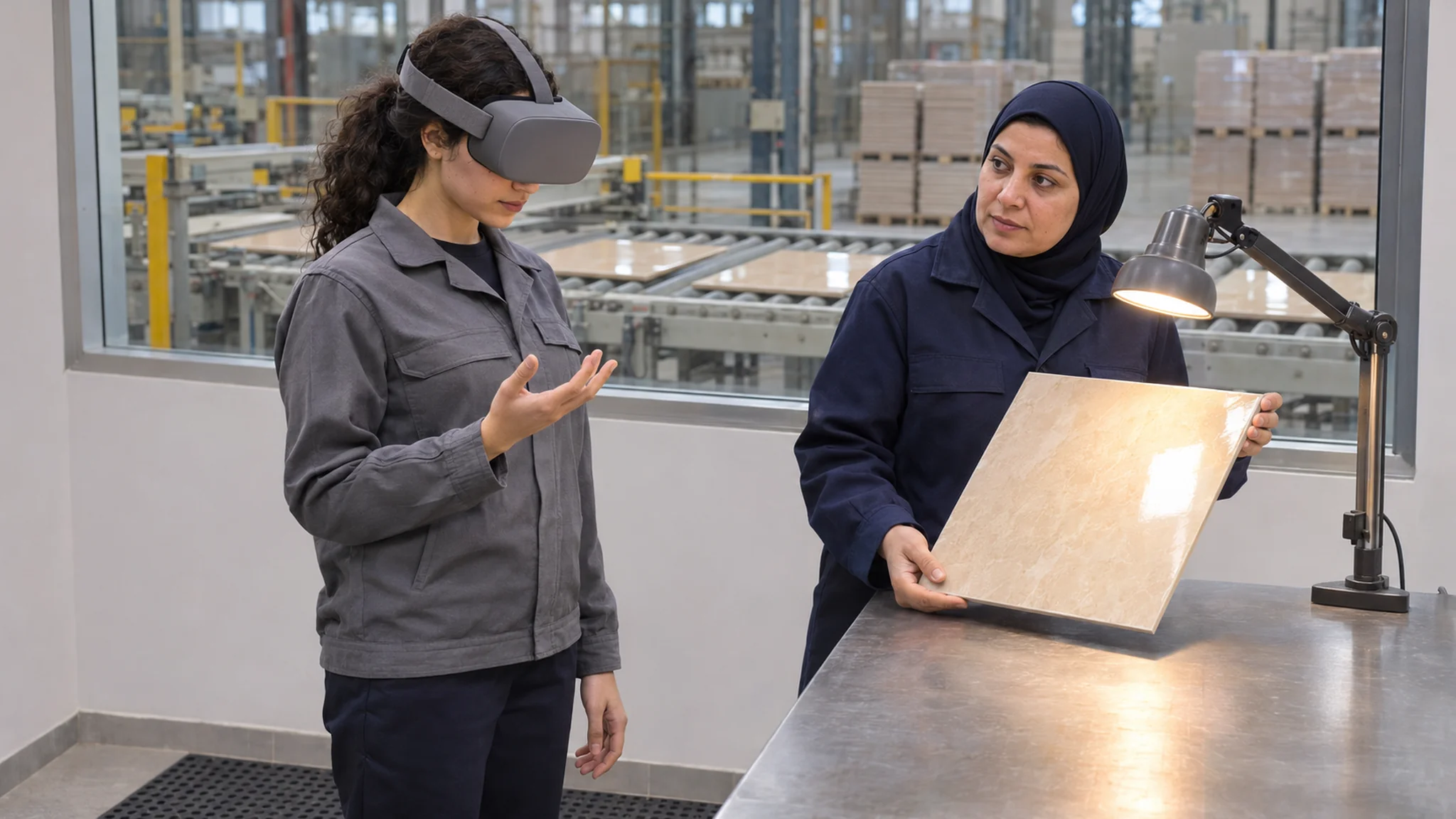
VR Training for Production Quality Decisions in Egyptian FactoriesA quality manager at a factory in 10th of Ramadan City has a puzzle. New inspectors pass the photo-based defect quiz with good scores, yet on the line they miss defects that experienced colleagues catch: a slight warp that only shows when you sight along the edge of a panel, a glaze flaw that appears under the angled light of the sorting station, or the same small mark repeating on every fourth item. When they do notice something, many hesitate to hold the output or call the shift quality lead.
Both problems involve seeing and deciding in a real space, under real lighting and time pressure, which a photo cannot fully reproduce. This is where virtual reality (VR) can help: it can place inspectors in a simulated version of their station, again and again, with defects that rarely appear on the real line. But VR training only helps if every scenario is judged against an expert standard and treated as preparation, never as a substitute for assessment on the factory floor.
This article shows quality, training, and operations teams in Egyptian factories how to choose which quality decisions belong in VR training, build spot-and-escalate scenarios, write the expert standard, and keep field assessment separate. If you are still deciding between augmented reality (AR) support and VR training, start with our guide to choosing AR or VR from the task.
Which Quality Decisions Belong in VR Training?Not every quality decision needs a headset. Photo-based cases, like those in our article on turning quality explanations into eLearning decisions in Egyptian factories, already work well for classifying a clear defect on a single part. VR training earns its place when the decision depends on something a photo cannot carry:
Research points the same way. In a review of 21 experimental studies of head-mounted displays in education and training, Jensen and Konradsen found headsets useful for understanding spatial and visual information and for skills tied to head movement, such as visual scanning and observation, which are close to what defect spotting requires. Outside such skills, they found no advantage over less immersive methods. The studies were of below-average quality and came from education and training, not factories, so treat this as a reason to target VR training narrowly, not as proof that it will work in your plant.
Two limits matter on the factory floor. VR cannot convey touch, so a decision that depends on how a surface feels belongs with real limit samples. And if your experienced inspectors cannot see the defect clearly in the headset, the scenario is not ready for VR training, however good the demonstration looked.
Building Spot-and-Escalate ScenariosEach VR training scenario should test three moments in order, because inspectors can fail at any of them:
The focus of this VR training is detection and escalation. Inspectors are not asked to diagnose the process or adjust the machine; that stays with the authorized role. A scenario that rewards an inspector for fixing the cause teaches the wrong boundary.
Build a mix of situations: clear defects, borderline items near the acceptance limit, repeat patterns that call for escalation, and clean runs in which nothing is wrong. Clean runs matter, because an inspector who holds everything is as costly as one who passes everything. Keep each run to a few minutes, so that several attempts fit into one VR training session and the debrief can focus on one decision at a time.
Write the Expert Standard Before Building the VR TrainingThe expert standard is the reference against which every decision in the VR training is judged. Write it before any 3D work begins, with a quality engineer, an experienced inspector, and a production supervisor in the room.
Experienced inspectors often find it hard to explain what they look for, because they have done it for years. Structured interviews help the VR training team capture it. In surgical education, cognitive task analysis uses observation and structured interviews with several experts to capture the task sequence and decision points, and a meta-analysis of 12 studies concluded that training based on it is an effective way to learn the cognitive skills of a procedure. A factory is not an operating theater, but the interview method transfers: ask each expert where they look first, what makes them pause, and what makes them call someone.
For each scenario, the standard should record:
Score notice, judgment, and action separately, so the debrief shows exactly where an inspector went wrong. Record the time taken to notice the cue if it helps the conversation, but never make speed the only measure. When acceptance criteria or limit samples change, update the standard and the affected VR training scenarios together.
Running VR Training Sessions on the Factory SitePlan VR training sessions around the shift pattern. A quiet room near the production hall, two or three inspectors per session, and a quality inspector who leads the debrief usually work better than a large group watching one person in a headset. Use the Arabic and technical terms people actually use on the floor, including English abbreviations, in VR training voice prompts and debriefs. Keep runs short, and let anyone stop and continue with a non-immersive version of the same cases.
In the debrief, ask the inspector to describe what they saw before revealing the expert decision, then compare their notice, judgment, and action with the standard. Over several sessions, look for patterns across the group. If most new inspectors miss the same cue, the problem may lie in the lighting, the limited sample, or the work instruction, not only in the VR training.
Why VR Training Does Not Replace Field AssessmentA VR training result shows how an inspector decides in a simulation. It does not show whether they can do the same on the real line, with real parts, real lighting and real colleagues. That is why field assessment stays separate: after VR training, each inspector is observed at the actual station by the quality department, using your existing qualification or sign-off process, before working alone.
Keep the two records apart. VR training data tells the training team where to coach; the field assessment decides whether someone is ready. A simulation score should never replace a supervisor’s sign-off, a customer-required qualification, or any certification your factory must hold.
A Hypothetical Example: Tile Sorting at an Egyptian Ceramics PlantThe following example is hypothetical and is included only to illustrate the method.
A ceramics plant in an Egyptian industrial city produces glazed floor tiles. At the sorting line after the kiln, new sorters miss two kinds of problems: small glaze flaws that only show under the angled light of the inspection station, and a defect repeated on consecutive rows that signals a problem upstream. The plant’s quality engineer and its most experienced sorter write the expert standard for six short VR training scenarios: two single borderline tiles, two repeat patterns that require holding the pallet and calling the shift quality lead, and two clean runs.
New sorters complete the scenarios in pairs at the start of their shift, three times over two weeks, with a debrief after each run. The quality engineer notices that most sorters spot the flaws but escalate late, so the next round of VR training adds a scenario in which a supervisor pushes to keep the line moving. Before any sorter works alone, the quality engineer observes them on the real sorting line and signs them off through the plant’s usual process.
SummaryVR training is useful for production quality decisions when the cue depends on space, viewpoint, pattern, or rare situations, and when the hard part is escalating under pressure. It adds little for decisions that photos, limited samples, or simple eLearning already teach well.
Build short spot-and-escalate VR training scenarios, judge every decision against an expert standard written with your quality team, and keep the field assessment on the real line separate and decisive. For the augmented reality side of the same factories, see our article on AR training for equipment maintenance teams in Egypt.
Click here if you want Skillup MENA to help you.