Loading...
Subscribe to Our Newsletter
Get the latest updates delivered straight to your inbox.

The ultimate L&D solution for upskilling your workforce.


© 2026 SkillUp MENA, Inc. All rights reserved
Subscribe to Our Newsletter
Get the latest updates delivered straight to your inbox.
The ultimate L&D solution for upskilling your workforce.
© 2026 SkillUp MENA, Inc. All rights reserved


 Share :


An Instructor-Led Workshop on Competing Priorities for Doha TeamsIt is Sunday morning at a company in Doha. The projects team needs both senior technicians on a client site all week. The maintenance team has the same two technicians on its rota for visits a service contract requires. Both managers email the operations director, who settles it in a corridor. Next Sunday, the same collision returns.
Conflicts like this are rarely about missing information. Each team knows what the other wants. What is missing is a way to negotiate shared resources such as people, time, and equipment, and a habit of writing down what was agreed. Neither comes from a slide about collaboration.
This article shows training and operations leads how to design a short instructor-led training (ILT) workshop in which two or more teams negotiate over a shared resource and leave with a recorded decision. It covers choosing the conflict, writing team briefs, running the negotiation rounds, the decision record, and follow-up. All scenarios are hypothetical.
Why Priority Conflicts Belong in an ILT WorkshopMost organizations try to settle competing priorities with a rule: a priority list, a booking system or escalation. Rules help, but they cannot anticipate every collision, and constant escalation teaches teams to argue upwards instead of with each other. The skill that needs practice is the conversation between the teams, and ILT is a practical place to build it.
That conversation is hard to rehearse alone or on a screen. An ILT workshop puts the people who compete for the same resource at one table, with a trainer who can pause the negotiation, ask a question, and restart it. Because the case comes from a real collision, what is agreed in the room can be used the following week. Hold the ILT session in a meeting room at your premises or at a venue you choose; it needs a table both teams can share and wall space for options.
Choose the Shared Resource Before You Design the ILT SessionStart with one recurring conflict, not with negotiation in general. Ask operations managers where teams compete most often, and pick a conflict that matters and keeps returning. Most fall into one of three types:
Then define what the ILT workshop cannot change. Contract dates, safety rules and approved budgets are fixed facts, not items to negotiate. Confirm who in the room can commit each team’s resource. If nobody can, invite the person who can, or the ILT session will end with a proposal instead of a decision.
Write an ILT Case Brief for Each TeamThe case pack has three parts: a common fact sheet, a confidential brief for each team and a blank decision record. The fact sheet sets out the resource, the period and the fixed constraints. Each team brief adds what that team must deliver, its deadline, what a delay would cost, and one or two concerns it would not normally say aloud, such as a client who has already complained.
Those concerns mark the gap between positions and interests. Writing for the Program on Negotiation at Harvard Law School, Katie Shonk describes positions as surface-level demands, with interests, meaning the underlying needs, motivations, and concerns, beneath them. Her example of two department heads fighting over a budget is the pattern this ILT workshop rehearses: a dispute fed by concerns neither side has stated.
Prepare two ILT cases rather than one, for example, a conflict over people and a conflict over equipment. In a study of negotiation training, Loewenstein, Thompson and Gentner found that management students who compared two cases were far more likely to use the trained strategy than students who studied the same cases separately.
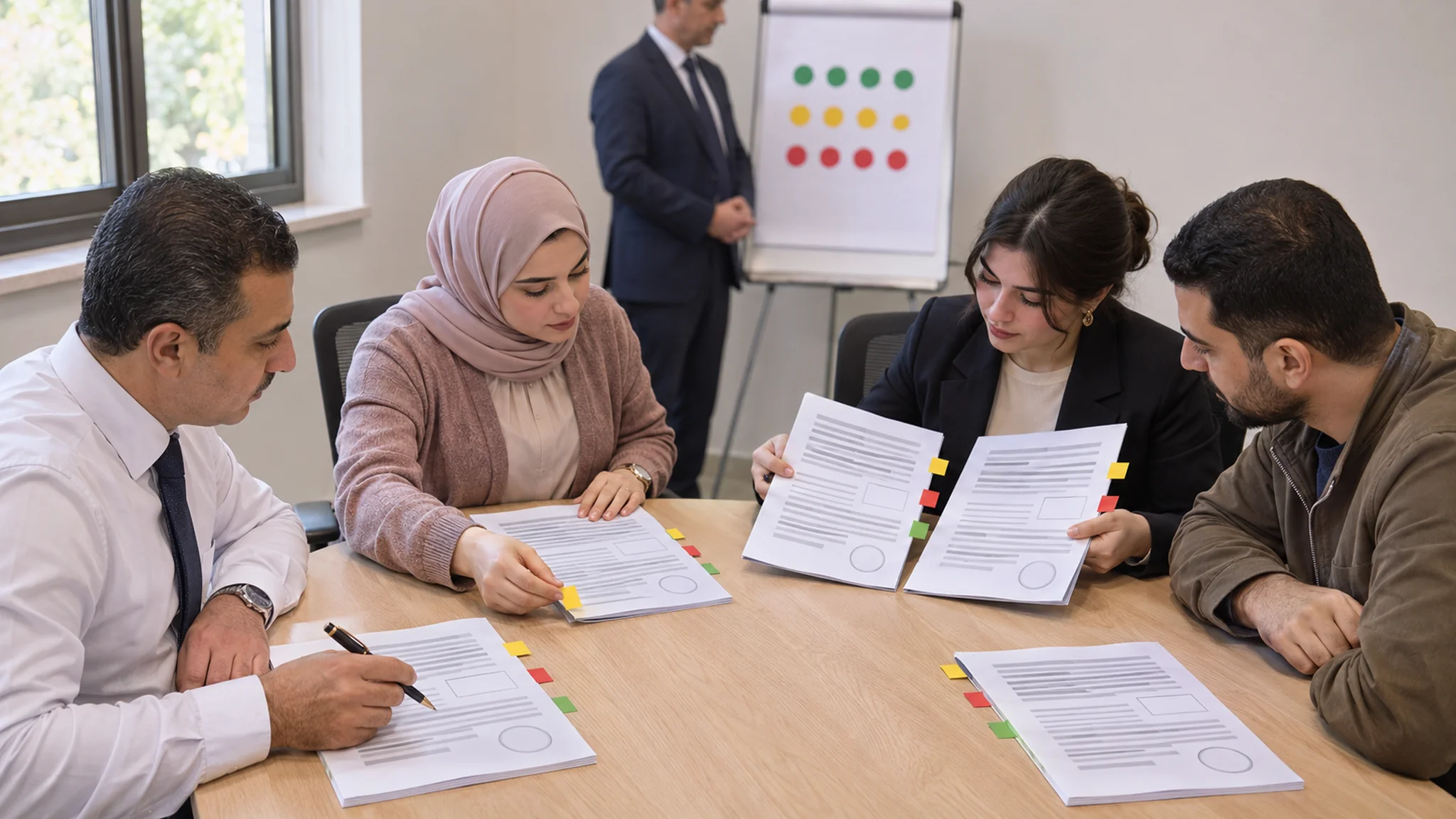
Running the Negotiation Rounds in the ILT SessionA half-day ILT workshop allows two cases, each followed by a debrief. Seat each team on its own side of the table, three or four people per team, and run four rounds. The ILT trainer keeps time, enforces the rules of each round, and never proposes a solution.
Round 1: State PositionsEach team states what it wants and by when, in two minutes, without interruption. The ILT trainer writes both positions on a flipchart. The round is short on purpose: it shows how far apart the teams look when they speak only in demands.
Round 2: Ask About InterestsEach team must ask the other at least three questions before proposing anything. Why that date? What happens if you have the resource for only part of the period? What is the least you need to meet your commitment? If a team slips back into arguing its position, the trainer pauses the round and asks for a question instead. Answers go on a second flipchart.
Round 3: Generate Options Before ChoosingTogether, the teams list at least four options before judging any. Typical options include sequencing the work, splitting the resource by day or shift, substituting another person or item, adding capacity, or a trade in which one team lends a resource now for priority later. Shonk notes that negotiators often stop searching once they reach a minimally acceptable agreement; in an ILT workshop, that usually means cutting the resource in half. Loewenstein and colleagues also found that trained participants proposed fewer compromises, so the trainer asks: is splitting it the best option, or only the first?
Round 4: Agree Criteria, Then DecideBefore choosing, the teams agree how to judge the options: contract obligations, customer impact, safety, the cost of delay or the effect on other teams. Agreeing the standards first, as principled negotiation recommends, stops the decision from becoming a contest of seniority. Then the teams choose and complete the ILT decision record.
The Output: A Recorded DecisionThe ILT workshop ends with a written decision record for each case, not with a list of lessons learned. Keep it to one page:
A representative of each team initials the record before leaving. In the final debrief, compare the two records: which interests made agreement possible, which option nobody mentioned until Round 3, and what escalation would have produced instead. This comparison is where the second case earns its place in the ILT session.
Running ILT for Doha’s Mixed TeamsTeams in Doha often bring together many nationalities and work in English, Arabic, or both. Agree the working language of the ILT session in advance and write the briefs in it; a team negotiating in its second language should not lose because of it. Allow extra time for Round 2, where most of the nuance sits.
Seniority matters too. If one team sends its manager and the other sends coordinators, the ILT workshop becomes an instruction rather than a negotiation. Ask for representatives of similar levels, and keep the decision owner as an observer who confirms the outcome. Because the cases come from your own operations, this works best as dedicated in-company training; for the trade-offs, see our guide to choosing between open courses and in-house training in Qatar.
A Hypothetical Example: An ILT Workshop at an Events Company in DohaThis example is hypothetical and shows only how the elements fit together.
An events and exhibitions company in Doha has two teams that keep colliding. The exhibitions team builds stands for trade shows; the corporate events team runs conferences and gala dinners. Both depend on the same five audio-visual technicians and two delivery trucks, and in busy months the operations director settles a conflict almost weekly.
The training lead designs a half-day ILT workshop with three representatives from each team and the director as an observer. Case one concerns the technicians in a week with a large exhibition build and a two-day conference; case two, the trucks on a single evening. In Round 2 of the first case, the exhibitions team learns that the conference needs only two technicians on its first day, and the events team learns that the exhibition’s critical work is the rigging on day one, not the whole week.
The first record divides the week by task rather than headcount, with a condition covering a late client change. The second trades truck priority on one evening for an extra technician later. After the ILT session, the director asks both teams to use the same record for real conflicts and to bring her only those they cannot settle.
Checking Whether the Workshop Changed AnythingJudge the ILT workshop by what happens to real conflicts over the next two or three months. Track how many still reach a senior manager, how many end with a written record, and how often a recorded decision is reopened. If conflicts keep returning over the same resource, the issue may be capacity rather than negotiation: a decision for management, not for the next ILT cohort.
Check, too, whether the disagreement is really about priorities. When teams clash because the information they pass on is incomplete, negotiation will not fix it; our guide to training employees on cross-department handover in Qatar deals with that problem.
SummaryCompeting priorities between teams are a negotiation, whether or not anyone calls them one. An ILT workshop gives that negotiation a structure: one real shared resource, a brief for each team, rounds that move from positions to interests to options, criteria agreed before deciding, and a decision record both teams initially.
Keep the cases real, compare two of them and follow the records afterwards. Where one team can practice a shared task on its own schedule, collaborative eLearning tasks for Qatar project teams may be enough. Where two teams must settle a conflict face to face, ILT lets them rehearse it before the next real collision.
Click here. If you are planning an ILT workshop around a real conflict between your own teams, you can discuss your instructor-led training requirements with the SkillUp MENA team.