Loading...
Subscribe to Our Newsletter
Get the latest updates delivered straight to your inbox.

The ultimate L&D solution for upskilling your workforce.


© 2026 SkillUp MENA, Inc. All rights reserved
Subscribe to Our Newsletter
Get the latest updates delivered straight to your inbox.
The ultimate L&D solution for upskilling your workforce.
© 2026 SkillUp MENA, Inc. All rights reserved

 Share :


Managing Small Groups in Omani Technical Classroom TrainingTwelve technicians, two practice benches, one trainer. In the first hour of a technical session at a company in Muscat, four people have their hands on the equipment. The other eight stand behind them, look at their phones or chat at the back of the room. By the afternoon, the most confident technician in each group has done most of the practice, and the quietest has barely touched a tool.
The problem is rarely the trainer’s knowledge or the quality of the equipment. It is how the groups are organized. When equipment is limited, a session needs a plan for what every person does at every moment: practice, observe, prepare, or check.
This article is for training and operations leads who run instructor-led training (ILT) for technicians in Oman. It does not discuss whether to choose a classroom format; it assumes the decision is made and shows how to manage small groups once they are in the room: group size, rotating roles, station rotation, waiting tasks, and the trainer’s circuit. All scenarios are hypothetical.
Why Small Groups Go Idle in Technical ILTMost idle time in technical ILT has three causes. First, there is one piece of equipment per group and only one person can use it at a time. Second, nobody has a defined job while waiting, so watching becomes passive. Third, the trainer gets pulled into the group with the hardest problem and stays there, while other groups stall.
Mixed experience makes it worse. A senior technician often takes over because it is faster, and newer colleagues let it happen. The ILT session ends on time, but the people who most needed practice have had the least.
Size ILT Groups Around the Equipment, Not the RoomStart the plan from the equipment, not from the number of seats. For hands-on technical skills training in ILT, groups of three or four per piece of equipment are usually workable: one person practices while the others have real tasks. With five or more, someone is always left with nothing useful to do.
If you have fewer pieces of equipment than groups, add ILT stations that use the same task without the equipment:
Then match the trainers to the active equipment. As a planning guide, one trainer can keep two active equipment stations under close supervision; more stations need a second trainer or a qualified assistant from the client’s own team. Write this ratio into the ILT plan before the date is fixed, not on the morning of the session.
Give Every Technician a Role in Each ILT RoundInside each group, give every person a role for each practice round, and rotate the roles so that everyone does each one:
In ILT run this way, observation becomes active work rather than waiting, and there is research support for mixing roles. In a study of balance practice, Shea, Wulf and Whitacre found that learners in pairs who alternated physical practice, observing their partner and discussing it on each trial at first performed worse, but quickly overtook learners who practiced alone and kept the advantage on a delayed retention test. When the forms of practice were done in blocks rather than alternated, results were generally poorer. A balance task is not a technical procedure, but the lesson for ILT is practical: alternate the roles round by round, rather than letting one person practice for an hour and another watch for an hour.
Keep the observer checklist short: five to eight steps, each something you can see, with space to mark the first deviation. After each attempt, the observer gives one minute of feedback before the ILT trainer adds anything. Our article on handling receiving exceptions with Oman warehouse teams shows the same structure built around a timed attempt and a rubric.
Plan the Rotation Timetable for Each ILT SessionWrite the rotation as a timetable, not as an intention. A workable pattern for a group of four is a round of twelve to fifteen minutes, with the roles moving one place clockwise at the end of each round. Four rounds give every technician one turn in every role, which takes about an hour per task at one station.
When there are more groups than equipment, move whole groups between stations as well. With three groups and two benches, for example, each group spends one hour at a bench and then thirty minutes at the desk station, so no bench stands empty and no group waits in a corridor. Print the timetable on one page and put it at every station; the ILT trainer should not need to announce every change.
Turn Waiting Time into PracticeEven with good rotation, every ILT session has short gaps: a reading takes time to settle, a component needs resetting, a group finishes early. Prepare waiting tasks linked to the same task, so a pause becomes practice rather than phone time:
Waiting tasks should be quick to start and quick to stop. If a task takes more than five minutes to explain, it belongs in a station, not in a gap.
The ILT Trainer’s Circuit and Individual Sign-OffIn technical ILT, the trainer needs a circuit, not a favorite group. Visit each active station at fixed intervals, read the observer sheets first, and spend time where they show the same deviation more than once. A trainer who reads the sheets can coach the right step in two minutes; a trainer who watches from the start of every attempt cannot reach every group.
In the last part of the ILT session, each technician completes one attempt alone while the trainer observes with the same checklist, and the others continue at the desk and review stations. That attempt shows who is ready for supervised work and who needs another round. It does not replace the company’s own competence assessment, authorization, or safety rules, which apply to every practice attempt on real equipment.
Practical Points for Omani Technical TeamsTechnical teams in Oman often combine Omani technicians with expatriate colleagues from several countries, and procedures may be written in English while discussion runs in Arabic. Prepare ILT procedure cards and observer checklists in the language the job documents use, and let groups talk in the language they work in.
Mix experience deliberately in every ILT group, and reshuffle groups at lunch so the same senior technician does not coach the same newcomer all day. Where equipment must be booked or moved before the session, our guide on what to request before a provider delivers training at Omani sites covers that preparation. Hold the ILT session in your own workshop or training room, or at a venue you choose, where the practice equipment can be set up safely.
A Hypothetical Example: Calibration Practice for Instrument TechniciansThis example is hypothetical and shows only how the elements fit together.
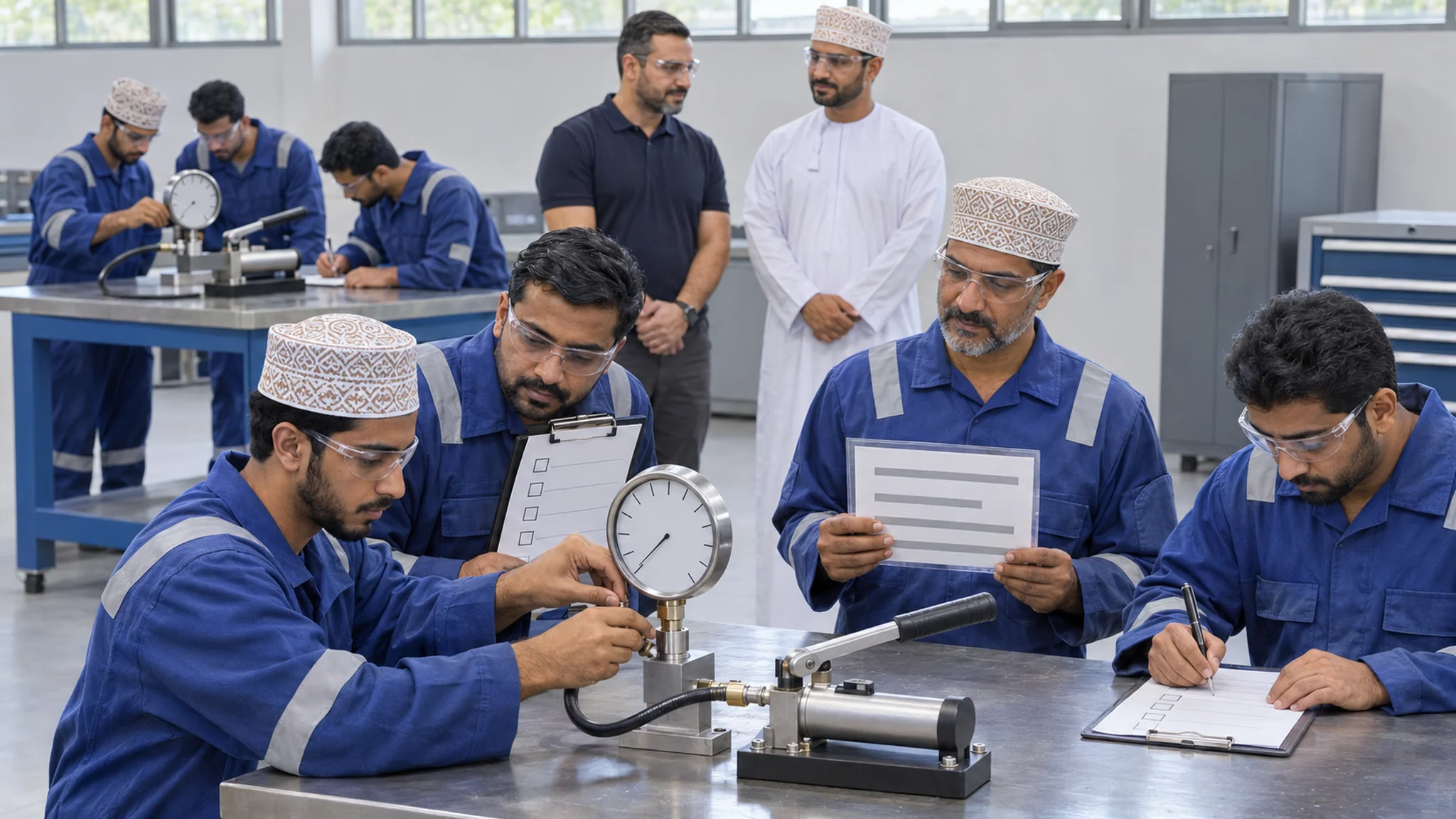
An oil and gas services company in Muscat needs twelve instrument technicians to practice a revised calibration routine for pressure gauges. It has two calibration benches for training and one ILT trainer, supported by a senior technician from its own workshop.
The training lead plans a one-day ILT session with three groups of four. Two groups work at the benches while the third works at the desk station, completing calibration record sheets from sample readings and finding planted errors in a completed sheet. Groups move every hour. At each bench, roles rotate every fifteen minutes, so each technician is operator, observer, reader, and recorder once per hour.
The observer sheets quickly show that several technicians skip the same check before recording the final reading. The trainer stops all groups for five minutes to demonstrate that step once, then returns to the circuit. In the afternoon, each technician completes one observed attempt alone; most complete it without prompts, and the company lists the others for a short follow-up ILT round before they work unsupervised.
SummarySmall groups in technical ILT go idle when only one person has a job. Size groups around the equipment, give every technician a rotating role, add stations when equipment is short, prepare waiting tasks tied to the same task, and keep the trainer moving on a circuit guided by the observer sheets.
Finish every ILT session with an individual attempt for each participant, and keep the checklists and cards current whenever the procedure changes, in the same way as updating eLearning when work procedures change in Oman. Planned this way, ILT gives every technician real practice, not a view over someone else’s shoulder.
Click here if you want Skillup MENA to help you.