Loading...
Subscribe to Our Newsletter
Get the latest updates delivered straight to your inbox.

The ultimate L&D solution for upskilling your workforce.


© 2026 SkillUp MENA, Inc. All rights reserved
Subscribe to Our Newsletter
Get the latest updates delivered straight to your inbox.
The ultimate L&D solution for upskilling your workforce.
© 2026 SkillUp MENA, Inc. All rights reserved


 Share :


Specifying Corporate Training Center Requirements in AlgeriaThe request starts with one sentence from an operations director in Oran: ‘Our team needs training on quality.’ By the time it reaches HR, it has become three different requests. The director wants fewer customer complaints. The line supervisor wants a course that takes her people off the floor for no more than a day. HR wants something that fits this year’s training plan and budget line. If the company now contacts a training center, that training center will quietly decide which of the three requests to answer.
That is why the most useful document in a training purchase is often one that no training center ever sees in full: a short internal requirements document, agreed by the people who will judge the result before anyone goes to market.
This guide explains how HR and training procurement teams in Algerian companies can build that document around five questions: the task, the audience, the assessment, manager support, and the constraints, and how to get the business owner, HR, and the line manager to sign it before approaching any corporate training center.
Why Requirements Come Before Any Training Center Is ContactedOnce the first proposals arrive, internal discussion shifts from ‘what do we need?’ to ‘which offer do we like?’. Disagreements that were never settled reappear as arguments about each training center proposal, and the most persuasive training center can end up defining the need for you.
Public-sector guidance on needs assessment makes the same point from another angle. The U.S. Office of Personnel Management guidance on training needs assessment describes it as identifying the gap between required and current performance, exploring its causes and the ways to close it, and considering the consequences of ignoring it. It also warns that training is sometimes not the best solution and virtually never the only one. A requirements document is where your organization records that thinking, in its own words, before any training center is invited to respond.
Who Writes Which Part Before a Training Center Is InvolvedThe document fails when HR writes it alone. Each part needs an owner who knows the answer and will later judge the result:
HR coordinates and writes the final version, but each owner drafts or corrects their part. That small change is what turns a training request into a shared commitment.
Some companies ask a corporate training provider to run a needs analysis first. That can add useful detail, but it works best after your three owners have agreed on the task and the gap. Otherwise, the analysis inherits the same disagreement, now described in the training center’s words rather than yours.
The Five Sections of the Requirements DocumentSection 1: The Task and the GapName one or two work tasks, not a topic. For each, describe what good performance looks like, what currently happens instead, and the evidence for the gap: complaint records, rework, error logs, or supervisor observations. Then list the causes that are not about skill, such as unclear procedures, missing tools, or conflicting instructions. If errors repeat across teams, our guide linking an L&D plan to recurring work errors helps decide which gaps deserve a training program at all. This is also the section a training center will read most closely, so write it in concrete terms a newcomer to your company would understand.
Section 2: The Audience a Training Center Will Design ForRecord who will take part: roles, number of people, sites such as Algiers, Oran or Sétif, shifts and experience levels. If your teams work in Arabic, French or both, note which language is used for documents, systems and conversations, because a training center needs to design for the language people actually work in. Where experience varies widely, decide now whether new and experienced staff should be trained together; our article on matching content to task and experience in Algeria shows why that choice matters.
Section 3: The AssessmentAgree how the business owner and the manager will judge success before any training center proposes its own test. Write down the evidence at the end of the program, such as a realistic task completed to a standard, and the evidence some weeks later, such as a sample of real work reviewed by the supervisor. Record the current baseline if you have one, so the later comparison is fair. If a training center later proposes a different assessment, you will be able to judge whether it is stronger than yours or simply easier to pass.
Section 4: Manager SupportOPM’s needs-assessment process includes clarifying the critical behaviors needed and defining the drivers required to sustain them. In practice, many of those drivers sit with the line manager. Ask the manager to commit in writing to a few concrete actions:
No training center can deliver these commitments on the manager’s behalf. If the manager cannot commit to them, record it. It is better to know before choosing a training center than to discover it when the results disappoint.
Section 5: Scope and ConstraintsFinish with the practical limits: the budget envelope, the date window, periods to avoid, acceptable formats, whether sessions can run at your premises, and anything explicitly out of scope. Keep it factual. This section tells a training center what it must work within, not how to teach.
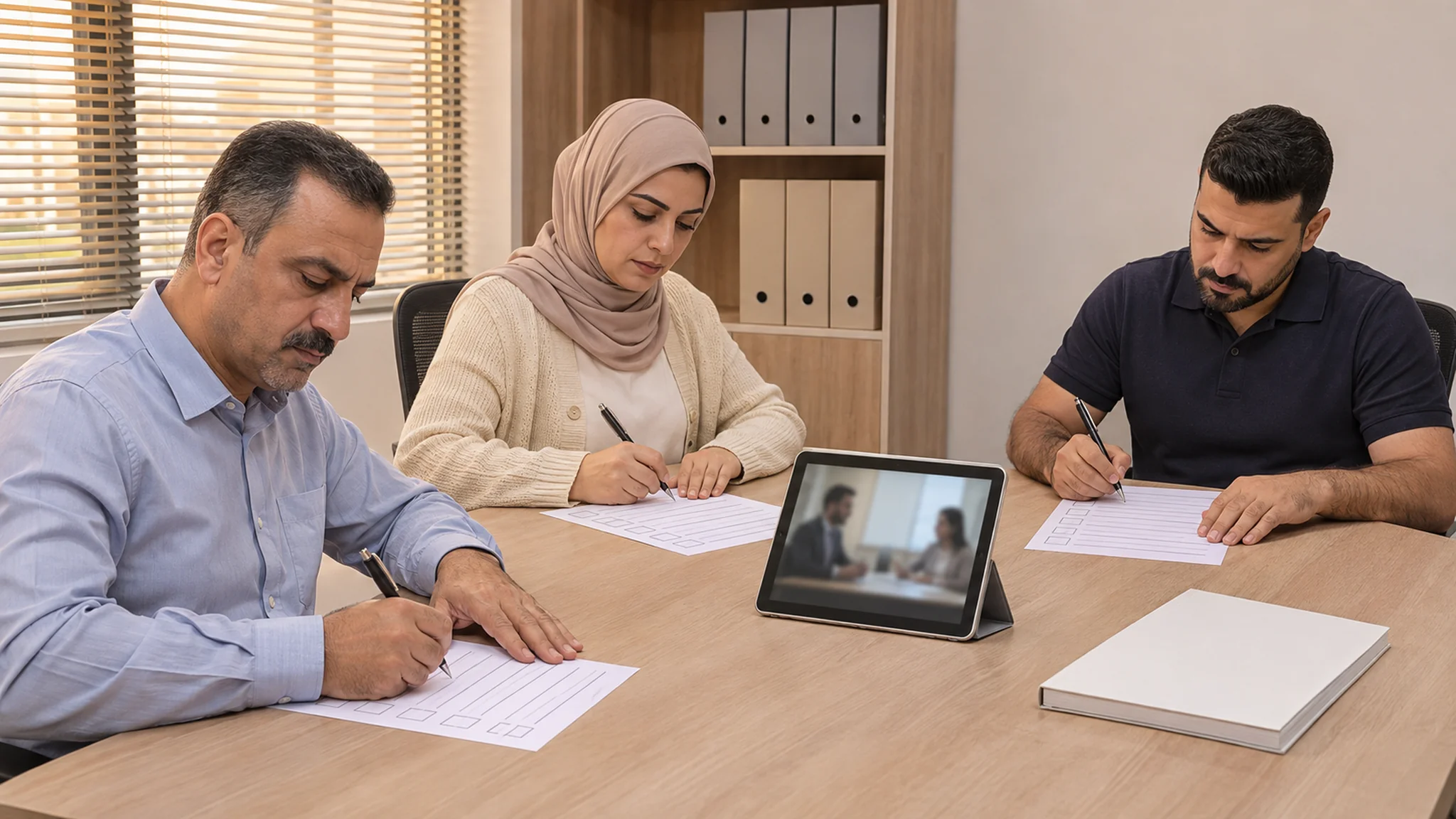
Agreeing and Signing Off InternallyHold one meeting of about forty-five minutes with the three owners. Read the document section by section and resolve each disagreement on the spot, or record it as an open question with a name and a date. Common disagreements are about the size of the gap, whether training is the right response at all, how much release time is realistic, and whether an external training center or an internal expert should deliver it.
End with a dated version and three initials: business owner, HR, and line manager. From that point, any change to the task, the audience, or the assessment requires the same three people. It sounds formal, but it protects the program from shifting expectations once a training center has started work.
Using the Document When You Approach a Training CenterThe requirements document is internal. Some parts, such as names, budget limits, or sensitive error data, should not leave the company in their raw form. Use it as the source for the request you send, and as the yardstick for every proposal you receive. For guidance on writing the request for proposals itself, see our article on defining scope in a request. From the document, a training center usually needs:
It does not need your internal disagreements, the manager’s individual commitments, or the budget ceiling in full. Those stay inside the company, where they guide your own decision.
When proposals arrive, check each one against the five sections. A training center that answers your task, audience and assessment precisely deserves a closer look; one that answers a different question, however well presented, does not, whatever its reputation.
A Hypothetical Example: Quality Inspectors at a Food Producer in SétifThe following example is hypothetical and is included only to illustrate the method.
A food-processing company near Sétif wants to reduce customer complaints about labelling errors. The production director first asks HR for ‘quality training’. Instead of contacting a training center straight away, HR drafts the requirements document with the director and the quality supervisor.
Section 1 narrows the task to one action: quality inspectors checking labels against the batch record and recording any non-conformity correctly. The evidence is a rising number of complaint records. One cause turns out not to be skill at all: an outdated checklist at one line, which the director agrees to replace. Section 2 describes twelve inspectors on two shifts, who read procedures in French and discuss them in Arabic.
Section 3 sets the assessment: a practical check on sample labels at the end of the program, and the supervisor’s review of non-conformity records a month later. Section 4 records the supervisor’s commitments, including a follow-up conversation with each inspector. The three owners sign the document, and only then does HR contact three providers with a request built from it. The first training center to reply asks to visit a line before quoting, which the team reads as a sign that it has understood the task.
SummaryA training request that has not been agreed internally will be interpreted by whichever training center answers it. Before going to market, agree the task and the gap, the audience, the assessment, the manager’s support and the constraints in one short document.
Give each part an owner, settle disagreements in one meeting, and sign the result. The requests you send will then be sharper, and every training center proposal can be judged against what your organization actually agreed it needs.
Click here. If you are preparing internal requirements for a training program in Algeria and would like to test them before going to market, the SkillUp MENA team can discuss your corporate training needs with you.