Loading...
Subscribe to Our Newsletter
Get the latest updates delivered straight to your inbox.

The ultimate L&D solution for upskilling your workforce.


© 2026 SkillUp MENA, Inc. All rights reserved
Subscribe to Our Newsletter
Get the latest updates delivered straight to your inbox.
The ultimate L&D solution for upskilling your workforce.
© 2026 SkillUp MENA, Inc. All rights reserved

 Share :


Selecting a Training Center for Industrial Supervisors in Eastern Saudi ArabiaA manufacturing plant in Dammam has just promoted eight senior technicians to shift supervisors. HR asks for training, and a training center proposes three days of ‘Supervisory Excellence’ in a hotel meeting room: leadership styles, communication, time management, and motivation. The production manager reads it twice and asks a simple question. Where in those three days will the new supervisors check a work permit, stop an unsafe job, take over a shift with a pump down, or correct a new operator without losing him?
Industrial supervision is a practical job done on the floor, in the control room and at the permit desk. A supervisor who understands leadership theory but has never practiced stopping a job in front of a contractor’s crew is not ready, and a classroom of slides rarely closes that gap. The right training center for industrial supervisors is the one that can make supervision itself practicable.
This guide sets out three criteria for HR and training buyers in the Eastern Province: the equipment and setting the training center will use, the domain expertise of the trainer, and a supervision exercise you can watch and score. It names no centers and recommends none. For the wider shortlisting process, see our guide on how to choose a training center for companies in Riyadh.
What Industrial Supervisors Actually Need to PracticeBefore reading any training center proposal, list the supervision tasks your new supervisors find hardest. In most plants and industrial contractors, the list includes:
Every item on that list involves equipment, paperwork, and people at the same time. That is why the setting matters as much as the content when you compare one training center with another.
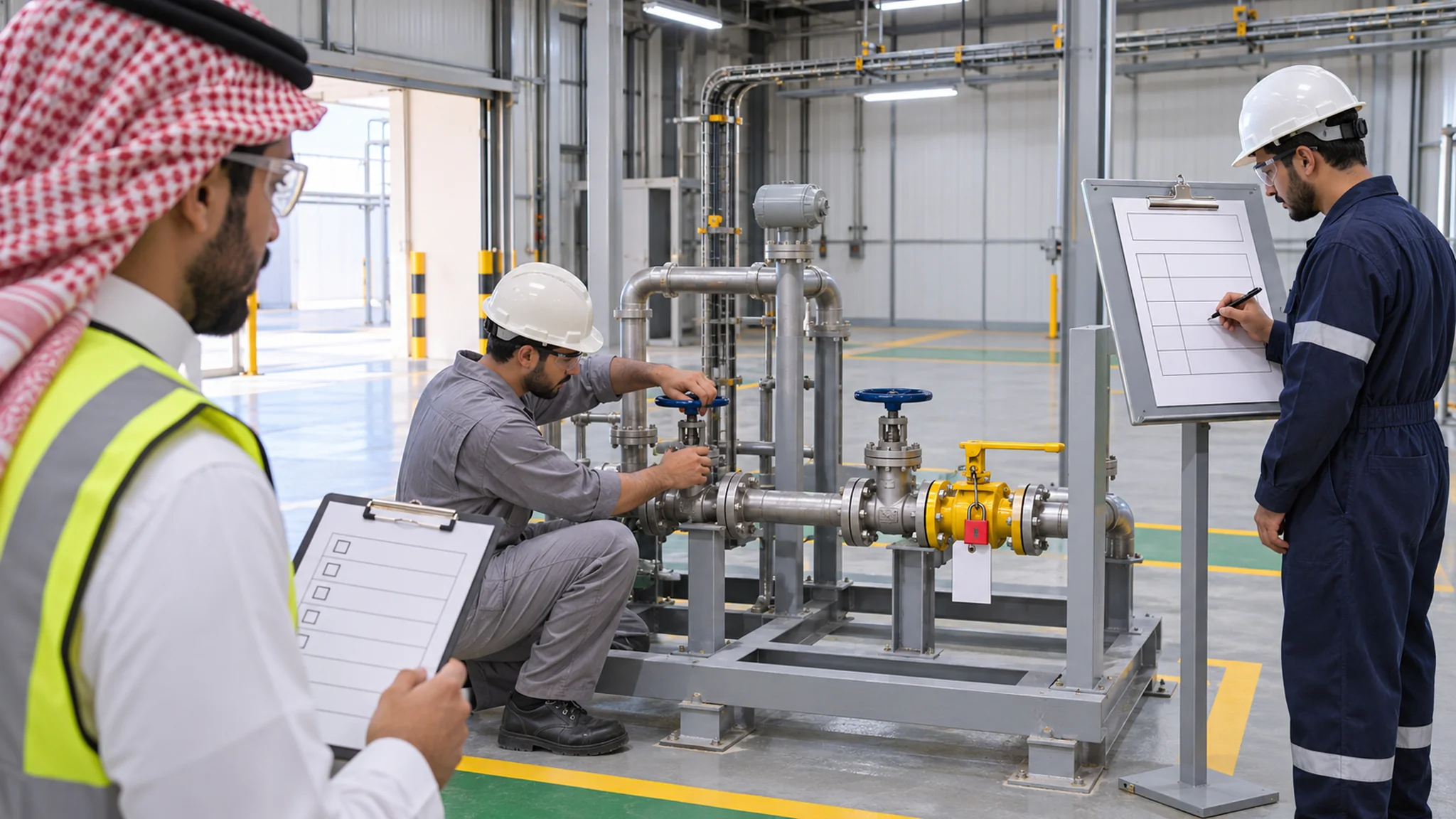
Criterion 1: Equipment and Setting That Make Supervision RealAsk each training center to describe, with photos or a short video, where supervisors will practice. A strong answer is a practice bay or mock work area: a small equipment skid with valves and an isolation point, a permit board with realistic forms, protective equipment, a radio and space for a crew to work while the supervisor observes. Ask also whether planted issues are part of the design, such as a missing signature on a permit, an unlocked isolation point, or a worker without gloves.
Check the training center’s setting against your own operations. A training center whose bay reflects fabrication work may not suit a process plant, and the reverse. If the center cannot build a suitable area, ask whether the exercise can run at your site in a non-operational area, planned with your HSE function so that nothing live is touched. Your own HSE requirements always decide what may be staged and where.
Some events, such as a gas release or a fire, cannot be staged safely at all. For those, a training center may propose video scenarios or simulation; our article on VR risk-response training for Saudi industry explains when that route is worth it. What should concern you is a proposal that lists no equipment and no setting at all, because the supervisors will then spend their time watching slides about tasks they will perform alone the following week.
Ask, too, how the practice bay will be used during the program. How many supervisors run the exercise at one time, how many crew members and observers are needed, and how many times does each supervisor get to lead a full run? A training center that plans for each supervisor to lead at least twice, with feedback between runs, is designing for practice; one that lets eight people watch a single demonstration is not.
Criterion 2: Domain Expertise, Checked Rather Than ClaimedA training center’s trainer for industrial supervisors needs more than presentation skills. Ask the training center for the work history of the trainer who will actually deliver: years as a supervisor or superintendent, the type of operation, such as a petrochemical plant, a fabrication yard, or a warehouse, and how recently they left the floor. Ask how they would handle two situations from your own plant, and listen for answers that show they have done the job.
Then verify what can be verified. The Technical and Vocational Training Corporation’s FAQs state that licensed private sector training facilities are licensed by TVTC, that TVTC issues trainer accreditation, and that an inquiry service lets anyone check licensed facilities and their accredited programs. If the training center is a private training facility, ask for its license details and check the facility and the program through that service. Whether a license applies to your particular arrangement, for example, a trainer delivering only inside your plant, is a question for your legal or procurement team, not for the training center’s sales representative.
References help where certificates cannot. Ask the training center for one reference from an operations or production manager, not an HR contact, at a company that sent supervisors through a similar program. Ask that manager one question: what did the new supervisors do differently on shift in the following months? A clear, specific answer is worth more than a long client list.
Language is part of domain expertise too. If your crews include workers who speak different languages, ask the training center how its trainer will handle instructions and feedback in the supervision exercise, and whether any of your bilingual staff can support the sessions.
Criterion 3: A Supervision Exercise You Can Watch and ScoreAsk each training center for the full script of its main supervision exercise, and the checklist observers use to score it. A useful exercise runs as a compressed shift of about forty minutes: the supervisor receives a handover with one ambiguous item, assigns three jobs, finds a permit with a missing isolation signature, notices a planted unsafe act, receives a radio call about a trip, and ends by giving feedback to a new operator. For the handover part, our guide to shift handover training for multisite Saudi companies describes what a good handover covers.
Look closely at the feedback step, for two reasons. Supervisors must learn to give feedback to their crews, and they must receive good feedback themselves during the exercise. In their widely cited review, Hattie and Timperley describe feedback as one of the most powerful influences on learning and achievement, while noting that its effect can be positive or negative depending on its type and how it is given. A checklist that scores ‘gave feedback: yes or no’ misses the point. A better one asks whether the feedback was specific to the task, said what to do differently, and was followed up.
Finally, ask the training center whether one of your experienced superintendents or an HSE adviser can observe and score alongside the trainer. Their scores will tell you more about the training program than any satisfaction form.
A Hypothetical Example: New Shift Supervisors at a Plant in DammamThe following example is hypothetical and is included only to illustrate the method.
The Dammam plant from the opening asks three providers for the practice setting, the trainer’s work history, and the exercise script. The first training center sends its hotel-based outline again. The second training center has a well-equipped bay but proposes a trainer whose experience is entirely in warehousing. The third training center sends photos of a small skid with an isolation point and permit board, names a trainer who supervised shifts at a process plant until two years ago, and attaches a forty-minute exercise script with a twelve-point checklist.
The plant checks the third training center and its program through the TVTC inquiry service, then asks for two changes: the permit form in the exercise is replaced with the plant’s own format, and the plant’s HSE adviser co-observes every run. After the program, each new supervisor repeats a shortened version of the exercise in a non-operational area of the plant, and the production manager compares the checklist scores with those from the first run.
The plant also asks the training center for a pocket version of the observation checklist. For their first month, each new supervisor is paired with an experienced superintendent, who uses the checklist on two real walk-rounds a week and discusses one point with the supervisor at the end of each shift. The training center’s exercise becomes the start of the supervisors’ development, not the whole of it.
SummarySelecting a training center for industrial supervisors in Eastern Saudi Arabia comes down to three questions. Does it have a setting and equipment that let supervisors practice the job? Does the trainer bring real plant experience, and can the facility and program be verified? Does it offer a supervision exercise that you can watch and score with your own people?
A training center that answers all three with photos, work histories, and a script is offering supervision practice. One that answers with a hotel room and a leadership model is offering a lecture, and your new supervisors will learn the rest on their own shift.
Click here if you want Skillup MENA to help you.