Loading...
Subscribe to Our Newsletter
Get the latest updates delivered straight to your inbox.

The ultimate L&D solution for upskilling your workforce.


© 2026 SkillUp MENA, Inc. All rights reserved
Subscribe to Our Newsletter
Get the latest updates delivered straight to your inbox.
The ultimate L&D solution for upskilling your workforce.
© 2026 SkillUp MENA, Inc. All rights reserved

 Share :


Selecting a Training Center for Facilities Teams in QatarA facilities management contractor in Doha asks for ‘technical training’ for forty technicians who maintain office towers and residential buildings. The proposal from one training center looks complete: three days covering company procedures and the work order system, HVAC maintenance, electrical basics and safety awareness, with certificates at the end. Read more closely, and only a few hours involve anyone touching a piece of equipment, and the proposal never says which equipment that would be.
This is the most common gap in facilities training proposals. Two very different kinds of content often sit in one training center proposal: administrative explanation, such as how to log a fault or what a service level means, and technical training, such as how to clean a fan coil unit’s drain tray without causing a leak. The first can be taught to a room of forty. The second needs equipment, a trade-experienced trainer, and time for each technician to do the task.
This guide shows HR and training buyers how to check whether a training center’s program fits a facilities team: separate the two kinds of content, check the equipment behind every technical module, match trainers to content, and assess each part in the right way. For the broader questions to send to any provider, see our article on procurement questions for choosing a corporate training center in Doha.
Two Kinds of Content in Every Facilities ProgramAdministrative explanation covers what a technician needs to know and follow: raising and closing a work order, the response times in your service contracts, permit paperwork, reporting a fault to the client, behavior in occupied offices and homes, and handover at the end of a shift. It can be delivered in a meeting room or online, to larger groups, by someone who knows your procedures, and checked with short scenarios.
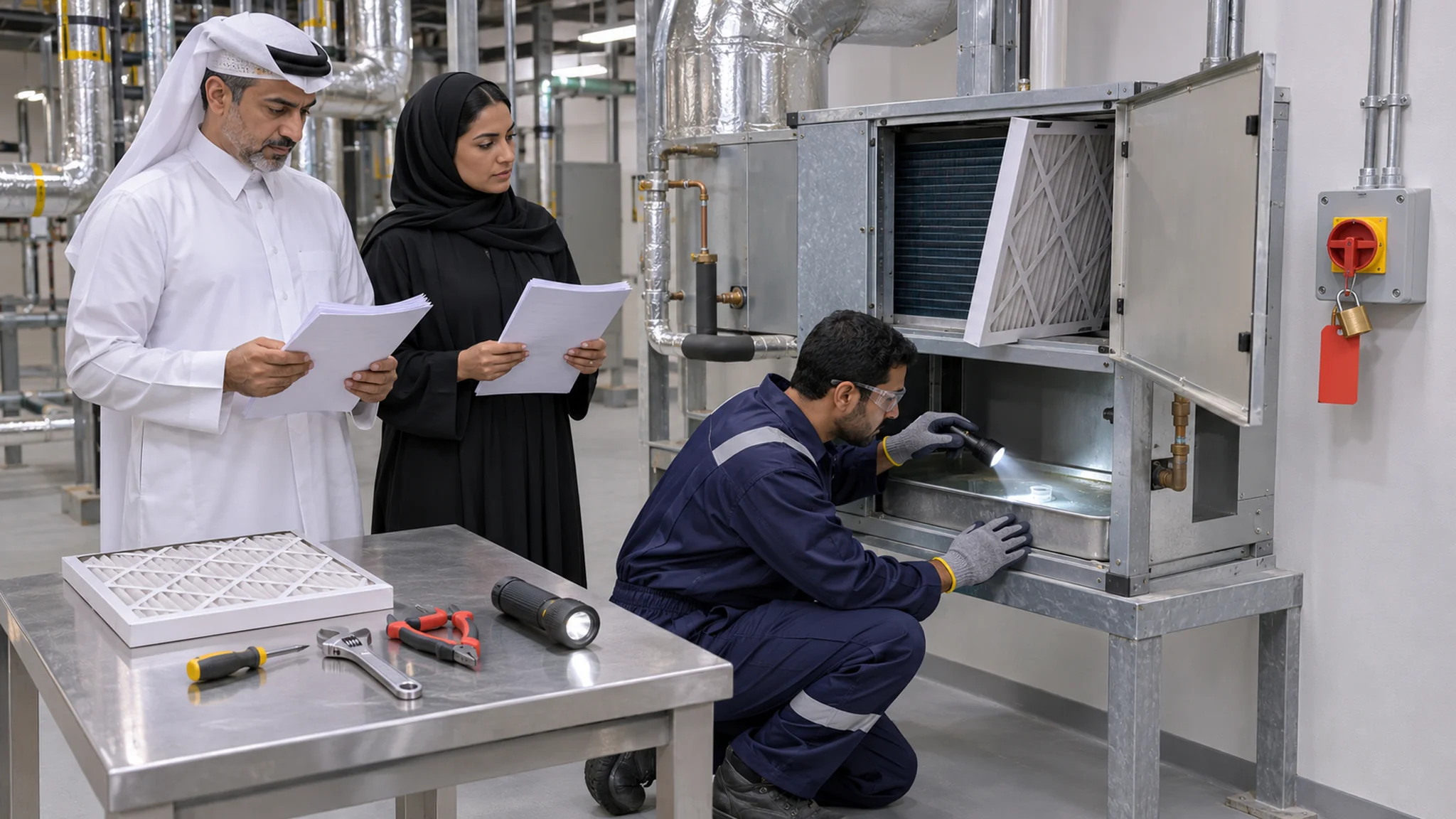
Technical training covers what a technician must be able to do with their hands and judgment: replacing filters and checking condensate drains, testing emergency lighting, resetting a tripped pump and finding out why it tripped, reading an alarm on a building management screen and deciding whether to escalate, or isolating a circuit before work starts. In Qatar’s climate, cooling equipment works hard for much of the year, so mistakes on these tasks quickly become tenant complaints.
Both matter. The problem starts when a training center presents them as one program, because the explanation modules make the technical ones look covered. A slide session titled ‘Chilled water systems’ is explanation, however technical its slides look.
Ask the Training Center to Map the Program Module by ModuleBefore comparing anything else, ask each training center to return a simple map of its training program, one line per module, with these columns:
Then read the map for warning signs: a technical module with no equipment listed, the same generalist trainer delivering both the policy session and the electrical module, practice time that appears only at the end of each day, or a multiple-choice quiz as the only check on a hands-on task. A training center that cannot fill in the equipment column for a technical module is offering an explanation under a technical title.
Decide What You Buy from the Training CenterOnce the map separates the two kinds of content, you may find that you do not need to buy both from the same training center. Administrative explanation depends on your own procedures, contracts, and systems, which your supervisors know better than any outside trainer. Many facilities teams are better served when an internal supervisor delivers the work order and service-level sessions, perhaps with the training center helping to structure them, while the external budget goes to technical modules, rigs and technical trainers.
The reverse also happens: a training center with a strong workshop may have weak procedural content, or the opposite. Score the two parts separately, and ask for a separate price for each, so that a well-equipped workshop is not hidden inside a long classroom program you do not need, and a weak technical module is not carried by a polished policy session.
Check the Equipment the Program NeedsEquipment is where facilities programs succeed or fail. For every technical module, settle four points with the training center before you sign.
Match to Your SitesThe training equipment should be the same type as the equipment your technicians maintain: if your buildings use fan coil units and a central chilled water plant, practice on a domestic split unit teaches only part of the task. Send each training center a list of the main equipment types on your sites and ask what it will use for each one. A training center that trains mainly on residential equipment may not be the right partner for a commercial portfolio, however good its trainers are.
Numbers and AccessThe U.S. Office of Personnel Management describes work sample tests as tasks that mirror the job, performed hands-on in a simulated work environment that copies the real one as closely as possible, and notes that they may not suit group administration. The same logic applies to practice: if twelve technicians share one training rig for an hour, each touches it for about five minutes. Ask each training center for the ratio of participants to rigs and the hands-on minutes each person will get.
Safe Isolation as Part of the TaskPractice on real equipment carries real risk. UK guidance from the Health and Safety Executive on maintenance of work equipment says maintenance should be done only by people who are competent and have received sufficient information, instruction, and training, that most maintenance should be carried out with the power off, and that machines should be locked off if power could be switched back on by accident. It is not a Qatari requirement, but it makes a useful test: ask the training center how its rigs are isolated, and whether isolation is practiced as a step of each task rather than mentioned in a safety slide. Your own HSE function should confirm what applies to your sites.
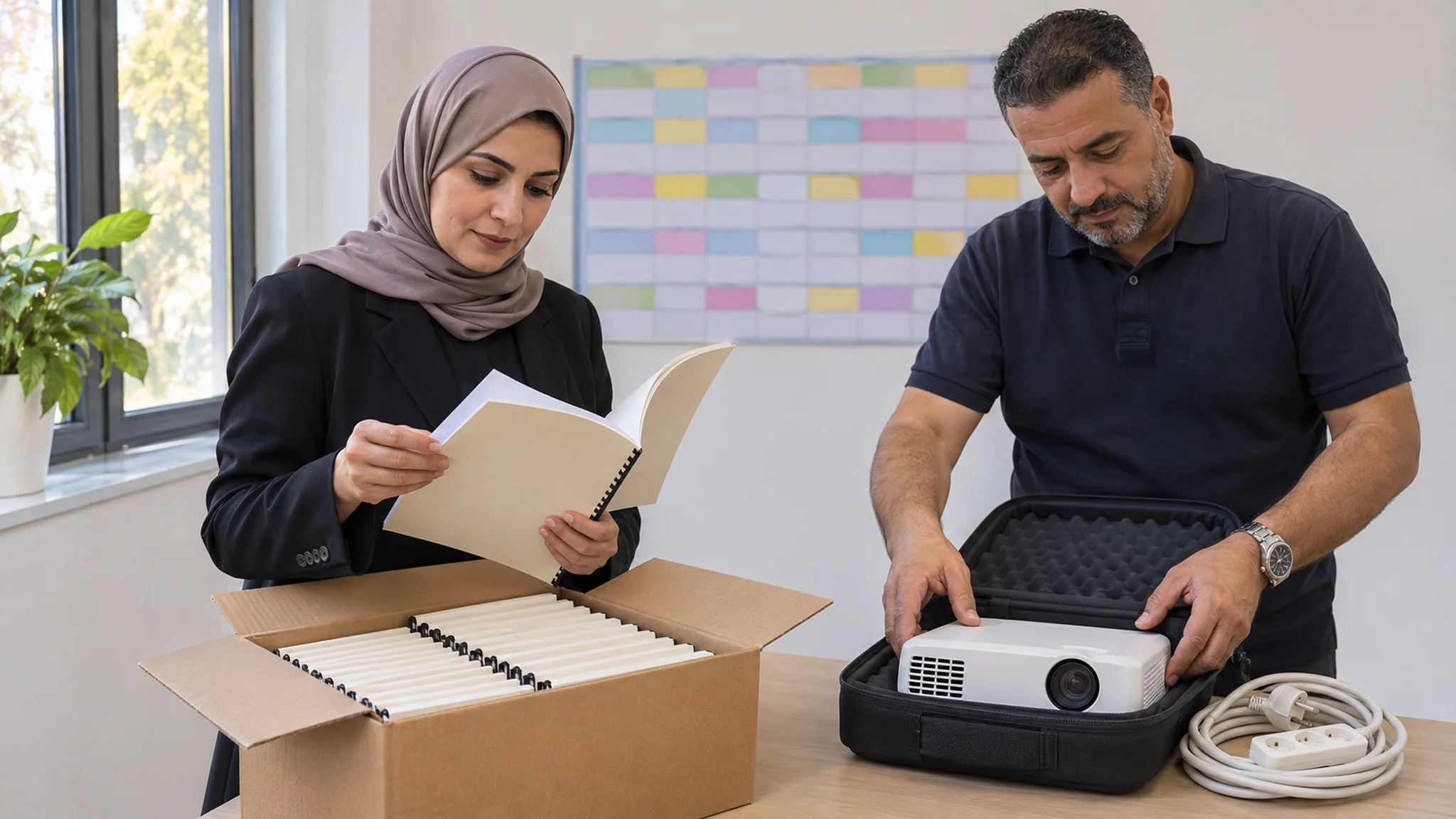
Tools, Consumables and Protective EquipmentAgree who supplies filters, test lamps, hand tools, and protective equipment, and whether technicians will use their own tools so the training matches the job. If part of the program uses your equipment instead of the training center’s rigs, plan the isolation and downtime with operations in advance. If you are also considering augmented reality guidance for some tasks, our article on AR training for Qatar facilities maintenance teams sets out the content requirements, and our guide to evaluating a health and safety course for warehouse teams in Qatar covers the separate question of safety courses.
Match the Trainer and the Assessment to Each Type of ContentAdministrative explanation is best delivered by someone who knows your procedures, your work order system and your contracts, often with one of your own supervisors in the room to answer site-specific questions. Technical modules need a technical trainer with recent hands-on experience on similar equipment, who can demonstrate a task, watch a technician repeat it, and correct the details. Ask the training center for each technical trainer’s trade background, not only their training experience.
Assess the two parts differently. For explanation, a short scenario check is enough: give a technician a fault report and ask them to raise the work order correctly. For technical tasks, ask for an observed work sample on the equipment, scored against a short checklist that includes the isolation step, with one result per technician returned by the training center. If your teams work across several languages, ask how instructions and checklists will be given in the language each technician understands best.
A Hypothetical Example: Office Towers in West BayThe following example is hypothetical and is included only to illustrate the method.
A facilities contractor maintaining four office towers in West Bay receives two proposals for its forty technicians. It asks both training center candidates to map their programs. The first training center’s map shows two days of classroom sessions, with ‘practical demonstrations’ by the trainer and no rigs listed. The second splits the program into one half-day of administrative explanation on the work order system and response times, and four half-days of technical training on two fan coil rigs, a pump rig and an emergency lighting board, in groups of eight.
The contractor chooses the second training center but asks for two changes: one of its own supervisors co-delivers the work order session using real, anonymized tickets, and each technical half-day ends with an observed work sample that includes isolating the rig. After delivery, the training center returns a checklist result for every technician, and the supervisors use it to decide who needs a second practice session.
SummaryA facilities program from any training center usually mixes two products: explanation of procedures and training in technical tasks. When selecting a training center for facilities teams in Qatar, ask for a module-by-module map, check that every technical module names its equipment, ratio, and isolation steps, and match trainers and assessment to each type of content.
A training center that can show you exactly where, on what, and for how long each technician will practice is offering technical training. One that cannot is offering a briefing, which may still be useful, as long as you buy it as one.
Click here. If you are reviewing a facilities training program and want help separating what needs a workshop from what needs a briefing, the SkillUp MENA team can discuss your corporate training requirements with you.