Loading...
Subscribe to Our Newsletter
Get the latest updates delivered straight to your inbox.

The ultimate L&D solution for upskilling your workforce.


© 2026 SkillUp MENA, Inc. All rights reserved
Subscribe to Our Newsletter
Get the latest updates delivered straight to your inbox.
The ultimate L&D solution for upskilling your workforce.
© 2026 SkillUp MENA, Inc. All rights reserved

 Share :


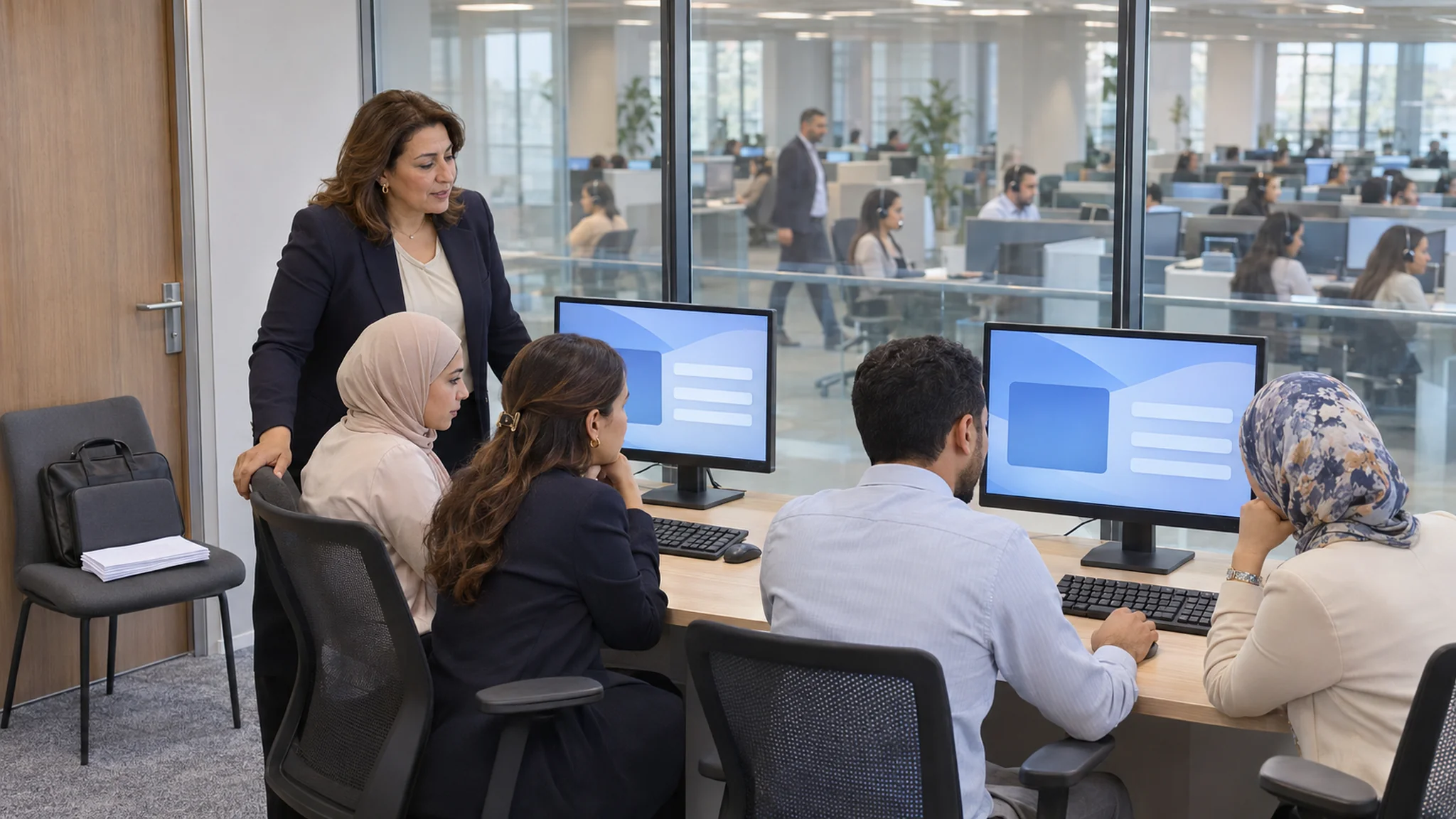
In-Company Training or an External Center in Morocco?The operations manager of a Casablanca contact center wants the next program to run on site, so that agents can practise on the real customer system. The HR manager would rather book a room at an external training center, because on-site agents are called back to the floor every time the queue grows. Both are right about something, and the program has not even started.
Where training happens, at your premises or at a training center, changes more than the address. It decides whether participants can use the equipment they work with, how close practice can get to real work, what information leaves the building, how much the operation is disrupted, and how many people can be trained at once. Those five questions rarely all point the same way.
This guide helps HR and training procurement teams in Moroccan companies compare in-company training with sessions at an external training center on those five criteria, and shows when splitting a program between two locations works best. It assumes you have already decided whether to build an internal team or buy from an external training center, and it does not recommend any training center or venue.
Criterion 1: Equipment — Can Participants Practise on What They Use?Start with the equipment the skill depends on. A classic study by Thorndike and Woodworth, published in 1901, found that improvement in one task seldom carried over fully to another, even a similar one, and concluded that practice spreads only where the two share identical elements. For workplace training, the practical lesson is simple: the closer practice is to the real machines, screens and forms, the less participants have to translate afterwards.
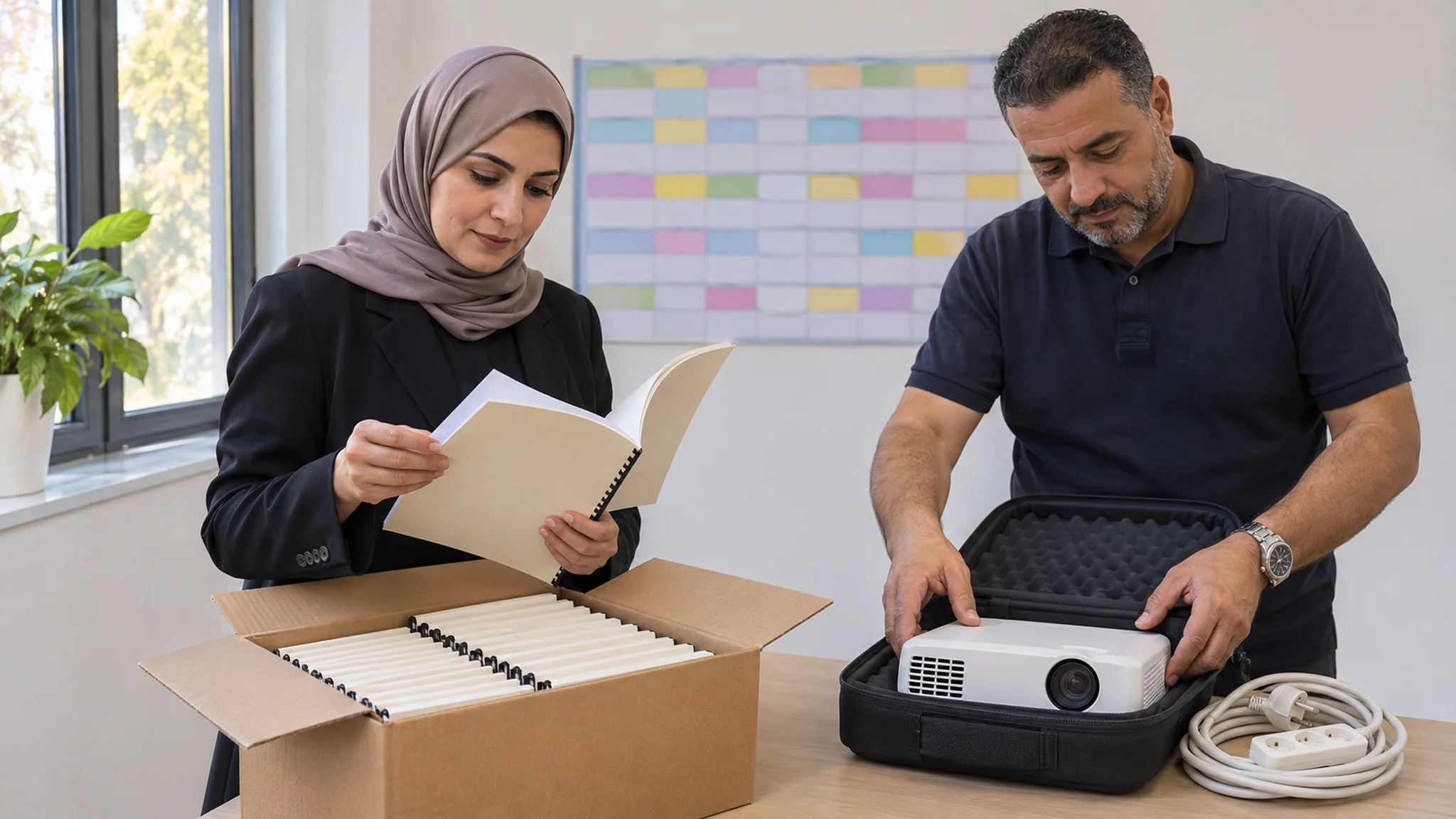
Ask three questions. Does practice require your own production equipment, tools or vehicles? Does it require your software, ideally a test environment with realistic data? Or can it be done with paper cases, role-plays and generic laptops? A training center can supply rooms, projectors and standard computers, but it cannot bring your production line or your client’s system into its building. For software, check with IT whether a test environment can be reached securely from an external training center; often it can be reached only from your own network.
If practice needs live equipment, safety becomes part of the decision. Training on a working line requires your safety rules, a supervisor present, and a plan that does not interrupt production. That usually favors your premises over any training center, at least for the hands-on part.
Criterion 2: Customization — How Close to Real Work Should Practice Be?At your premises, a trainer can walk participants to the workstation, use the forms in the drawer, and invite a supervisor to demonstrate a step. Cases can come from yesterday’s work. At an external training center, all of that has to be prepared in advance and carried in, and something is usually lost on the way.
Location also shapes what happens after the session. In their review of training transfer research, Burke and Hutchins group the factors that affect transfer into learner characteristics, the design and delivery of the intervention, and influences from the work environment.
Training on site keeps the work environment close: supervisors can drop in for the last hour, and participants can try the method on a real task the same afternoon. Training at an external training center puts more distance between learning and work, which helps reflection but makes the link to daily routine something you have to plan.
For topics that are not tied to your context, such as presentation skills, time management, or general leadership, that distance matters less. A neutral room at a training center can even help participants step back from the daily pressure and speak more freely.
Criterion 3: Confidentiality — What Leaves the Building?Every location has its own confidentiality risks, and they are different. At an external training center, the risk is what travels: printed cases, laptops with live data, recordings of role-plays, and conversations in shared corridors where other clients of the training center may be present. On site, the risk is who enters: the external trainer sees your premises, your screens, and possibly client information on the walls.
Decide the controls before choosing between your premises and a training center:
If the controls cannot protect the material at a training center, for example because practice needs real client screens, the decision is made: the program, or at least that part of it, stays inside the company.
Criterion 4: Disruption — Who Gets Pulled Back to Work?Disruption works in both directions. On site, participants are close to their work, so they are called to the floor, answer messages, and leave early when something urgent happens. Managers drop in to ask quick questions. A session that looks efficient on paper can lose a third of its practice time to interruptions.
At an external training center, the interruptions mostly stop, but travel time is added. In a large city such as Casablanca, getting a group to an external training center and back can take a meaningful part of the day, and participants coming from other cities need accommodation. The operation still loses the same people; it simply loses them for longer.
Both can be managed. On site, use a room on a different floor, collect phones during practice, agree a shift cover plan with the operations manager, and schedule sessions outside peak hours. Off site, choose a training center close to where most participants work and shorten the day rather than adding long evening sessions.
Criterion 5: Numbers — Rooms, Groups and ShiftsFinally, count. How many people need the program, how many can leave work at the same time, and how many each room can hold for real practice, not just for seating? A meeting room that seats twenty may hold only eight people practising at workstations. A training center can often provide larger rooms or several rooms in parallel, which helps when a big group must be trained in a short window.
Shifts and sites change the arithmetic. Teams working three shifts rarely fit a full-day program at an external training center; short sessions on site, repeated for each shift, often work better. A company with sites in Casablanca and Tangier must also decide whether the trainer travels to each site or participants travel to one training center, which affects cost, disruption, and consistency.
Reading the Five Criteria TogetherMark each criterion as favoring your premises, favoring an external training center, or neutral. Then look at which criteria are decisive. Equipment and confidentiality often settle the question on their own: if practice needs your production line or real client data, the hands-on part stays on site. Disruption and numbers are usually negotiable through scheduling, room choice, and group size.
When the criteria split, so can the training program. A common pattern is to run the concepts, discussion and soft-skill practice at an external training center, then run hands-on practice on site in small groups. The reverse also works: a short on-site session first, followed by a reflective day at the training center. If any part runs at your premises, prepare it properly; our article on what to request before a provider delivers training at your sites explains the equipment list, site visit, and coordination involved.
A Hypothetical Example: A Contact Center in CasablancaThe following example is hypothetical and is included only to illustrate the method.
The contact center from the opening must train sixty agents, who serve customers in French and Arabic, on a new version of its customer management system and on handling escalated complaints. The HR manager scores the five criteria. Equipment favors the premises: the test environment can be reached only from the company network. Confidentiality favors the premises too, because escalation cases include client account details. Disruption favors an external training center, since agents on site are called back during peaks. Numbers are neutral: the on-site training room holds twelve people at workstations, and a training center room of similar size would need the same five groups.
The company splits the program. The system practice runs on site, in a training room on a separate floor, in five groups scheduled in the quieter morning hours, with phones collected and a cover plan agreed with team leaders. The complaint-handling module, which uses anonymized cases and role-plays, runs for one day per group at an external training center, where agents can practise difficult conversations away from the floor. The HR manager asks the trainer to begin the on-site sessions with a short recap of the off-site role-plays, so that the two parts connect.
SummaryIn-company training and training at an external training center each solve different problems. Compare them on equipment, customization, confidentiality, disruption, and numbers; treat equipment and confidentiality as the criteria most likely to decide, and manage the rest through scheduling and room choice.
When the criteria disagree, split the program between the two locations rather than forcing one answer. And once you know which part will run off-site, our guide to choosing a corporate training center in Casablanca helps you select the right partner for it.
Click here. If you are deciding where a program for your teams in Morocco should take place and want to talk the options through, the SkillUp MENA team can discuss your corporate training requirements with you.