Loading...
Subscribe to Our Newsletter
Get the latest updates delivered straight to your inbox.

The ultimate L&D solution for upskilling your workforce.


© 2026 SkillUp MENA, Inc. All rights reserved
Subscribe to Our Newsletter
Get the latest updates delivered straight to your inbox.
The ultimate L&D solution for upskilling your workforce.
© 2026 SkillUp MENA, Inc. All rights reserved


 Share :


Choosing a Training Provider for NGO Teams in SyriaA programme office in Syria needs to train twelve programme assistants to write the monthly progress reports that feed into donor reporting. Three offers arrive: one from a training center that lists ‘report writing’ among sixty course titles, one from a consultancy that has worked mainly with banks, and one from an independent trainer recommended by a colleague in another organization. All three promise practical sessions. None says what happens if half the participants join from a field office with an unstable connection, or who checks the examples before they reach the room.
For NGO teams and teams implementing UN-funded programmes, those unanswered points often matter more than the course outline. Participants are spread across offices, work in Arabic with English templates, and handle information that must never appear in a training exercise. A training center that does excellent work in a corporate setting can still be the wrong choice if it has never seen the task your staff performs, cannot reach all of them, or brings content nobody in your organization has reviewed.
This guide sets out the questions to put to any training provider, whether a training center, a consultancy or an individual trainer, before you sign: questions about task experience, accessibility for every participant and content review. It is general guidance. Your organization’s procurement rules, policies and donor requirements always take precedence, and the guide does not name or recommend any provider.
Start with the Task Your Staff PerformWrite down the task before you read any offer: what the employee produces, for whom, using which template or system, and what a reviewer currently sends back. ‘Report writing’ is a topic. ‘Turning a month of activity records into a two-page progress report that a programme manager can approve without rewriting it’ is a task, and it gives every training center something specific to answer. If you have not yet agreed which tasks matter most across your teams, identifying learning and development needs for NGO teams in Syria is the better first step.
Then ask each training center to show its task experience, not its familiarity with the subject in general:
A sector reference can help you describe what good performance looks like. The CHS Alliance states that competent and well-managed staff are at the heart of an accountable and effective organisation, and describes its Core Humanitarian Competency Framework as a useful reference point for the sector. Some organizations use it to phrase the behaviors they expect, then ask each training center to show where its training program builds them. Treat it as a reference only: it does not certify or approve any provider.
Be cautious with answers that list course titles, certificates issued, or the number of people trained. A training center that has genuinely worked on your task will ask you questions back: who reads the report, what a returned report looks like, and how much time staff actually have to write it.
Check Accessibility for Every ParticipantIn NGO settings, the staff who most need training are often the hardest to reach: colleagues in field offices, people working shifts, staff with limited data or devices, and staff with disabilities. Accessibility is therefore a criterion for choosing a training center in its own right, not a detail to settle after contracting. Describe your real group to each training center by location, connection, device, and need, and ask how it would reach every person in it.
For recorded or online material, ask what each training center supplies as standard. The W3C Web Accessibility Initiative’s guidance on making audio and video media accessible covers captions for people who are Deaf or hard of hearing, transcripts, audio description for people who are blind, and sign language where the audience needs it, and it advises planning for accessibility from the very start of a project. A training center that treats captions and transcripts as an extra to be added after delivery has probably not planned for them.
You can run a quick first check yourself. W3C’s Easy Checks include image text alternatives, headings, color contrast, zoom, captions, and transcripts. W3C notes that they are quick rather than exhaustive, and that a page can pass them and still have significant barriers, so use them to screen a training center’s online materials, not as a full evaluation.
Then ask the practical questions that decide whether everyone can take part:
If some sessions will run live online, see our guide to live virtual training for distributed NGO teams in Syria for keeping participants active across locations.
Agree How Content Will Be Reviewed Before DeliveryContent that a training center wrote for other clients can be accurate in general and still wrong for your organization: a different approval threshold, a report format your donors do not use, or an example that would be inappropriate in your context. Before contracting, agree with the training center who will review the content, against what, and by when.
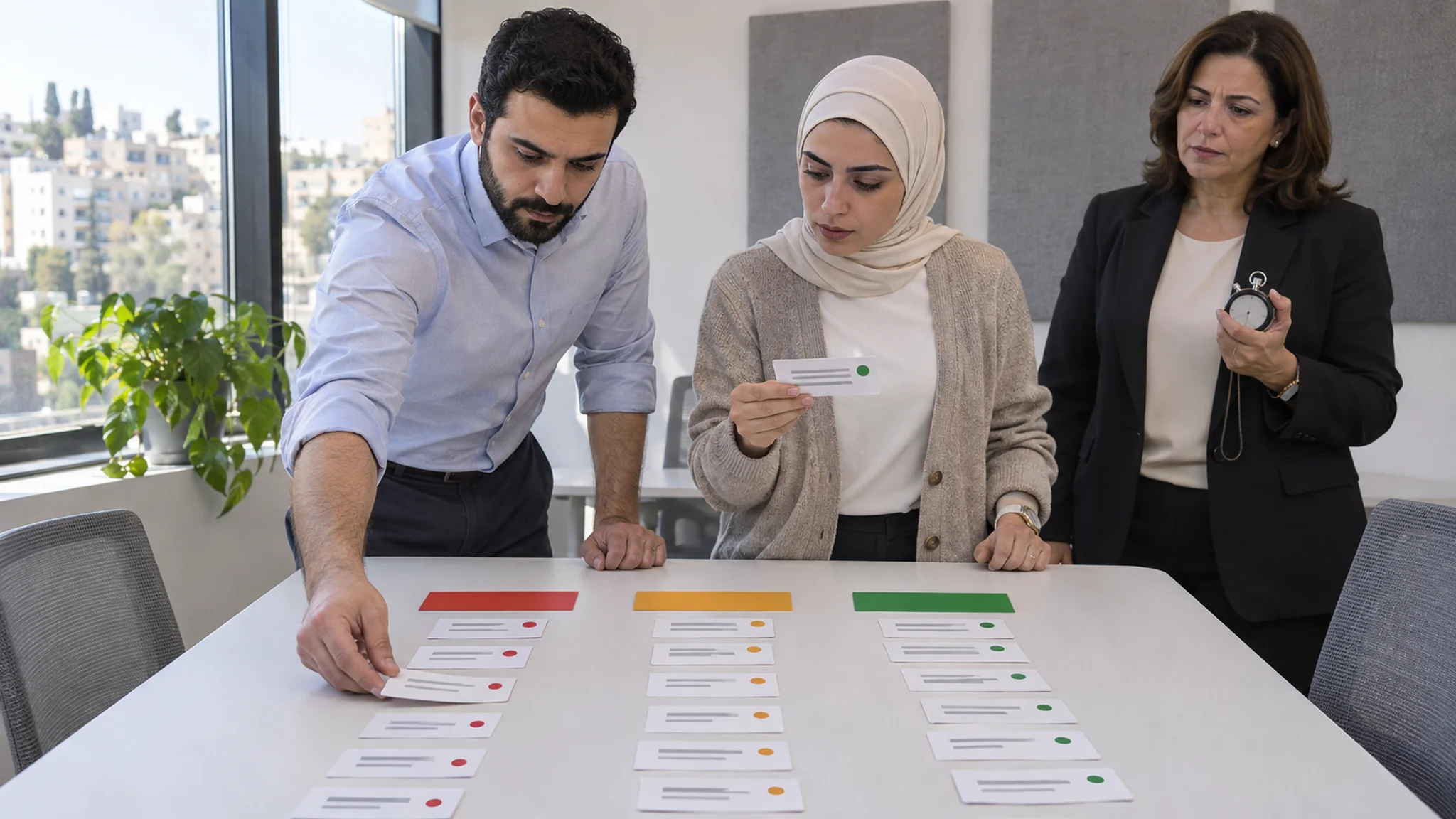
A workable content review has three parts. First, a subject review by the person who owns the task in your organization, such as the reports focal point or the finance officer, who checks every rule, template, and example against current procedures and donor requirements. Second, a sensitivity review: exercises use fictional names, amounts, and places only, and leave out beneficiary information, protection and safeguarding cases, security procedures, and the locations of offices or staff. Third, a language review by staff who will attend, confirming that the Arabic terms are the ones your teams actually use.
Ask the training center to put a version date on the reviewed materials, to send the final set a few working days before delivery, and to confirm that no unreviewed slides or cases will be added on the day. If the content will later become self-paced practice, our guide to turning NGO manuals into practical eLearning tasks in Syria shows how to keep the same review discipline.
Questions to Settle Before You SignA few final questions turn a good impression into commitments you can check later:
Treat the last point with care. A training center’s statement that it is ‘approved’ or ‘registered’ with an organization or agency is a claim to verify with that body, not evidence in itself. Your own procurement rules and donor requirements decide which providers you may contract; this guide does not address eligibility.
A Hypothetical Example: Monthly Progress Reports in a Homs OfficeThe following example is hypothetical and is included only to illustrate the method.
A programme office in Homs, with staff in two smaller field offices, wants twelve programme assistants to write monthly progress reports that managers can approve on first reading. The reports focal point describes the task in one paragraph and attaches a fictional, completed report as a model.
The first training center replies with its standard report-writing outline and cannot say who the trainer will be. The second training center offers a capable trainer whose experience is entirely in banking reports. The third training center names a trainer who has written and reviewed programme reports, sends one sample exercise in which participants turn fictional activity notes into a report section, and asks how many assistants will join from the field offices.
Before signing, the office asks the third training center for transcripts of two short recorded explanations, printable versions of all exercises, and a split schedule so field staff can join in two shorter blocks. The reports focal point reviews the exercises, replaces one example that resembled a real activity too closely, and adds the office’s own approval checklist. Three weeks after delivery, the trainer and the focal point review a sample of real reports against that checklist.
SummaryChoosing a training provider for NGO teams in Syria depends less on the course outline than on three questions: has this training center worked on the task your staff actually perform, can every participant take part fully, and who will review the content before it reaches the room?
Put the same questions to every training center or trainer on your list, verify claims rather than accept them, and write the answers into the agreement. A training center that welcomes those questions is far more likely to deliver a training program your teams can use the following week.
Click here if you want Skillup MENA to help you.