Loading...
Subscribe to Our Newsletter
Get the latest updates delivered straight to your inbox.

The ultimate L&D solution for upskilling your workforce.


© 2026 SkillUp MENA, Inc. All rights reserved
Subscribe to Our Newsletter
Get the latest updates delivered straight to your inbox.
The ultimate L&D solution for upskilling your workforce.
© 2026 SkillUp MENA, Inc. All rights reserved


 Share :


Choosing a Corporate Training Center in CasablancaAn HR manager at an auto-parts distributor in Casablanca has three providers on her shortlist for a program for the inside sales team. Each training center has sent a polished brochure, mostly in French, and each says sessions can run ‘in Arabic and French’. Her team speaks Darija with most customers, writes quotations in French and searches a product catalog that mixes French and English part names. Which of the three will her team actually follow, practice with and use the next morning?
No brochure answers that question. A sample of the real program does, and so does a clear answer to two further questions: in which language will the facilitator explain, run practice, and give feedback, and how will the training center find out whether people apply the program at work?
This guide shows HR and procurement teams in Casablanca companies how to choose a corporate training center by comparing sample modules, checking the language of facilitation against the way their teams really work, and asking how application will be evaluated. Because language use differs from one company to another, every language point is framed as a condition to check, not an assumption.
Ask Every Training Center for the Same Sample ModuleA sample is only useful for comparison if every provider answers the same brief. Choose one module from the program you need, ideally the one closest to daily work, and send the same short description of it to each training center on your shortlist. Ask for:
Ask also for a short recording of the facilitator running part of the module, ten to fifteen minutes, or a live demonstration if recording is not possible. A training center that agrees to the same brief as its competitors is easier to compare, and one that sends only a generic brochure page instead has told you something useful. If part of the program will run online, the same request applies; our guide to designing multilingual VILT for Moroccan teams covers what to look for in live virtual sessions.
Be fair about what you ask. A sample module takes effort to prepare, so keep the brief to one module, give every training center the same deadline, and agree in writing that you will use the material only to evaluate the offer. That makes serious providers more willing to show real work rather than marketing pages.
Read Each Training Center’s Sample as a Design, Not a BrochureLay each training center’s sample beside the others and read them as a participant would. Look first at the timings: how much of the module is participants doing something, and how much is listening? Then look at the practice activity. Does it use situations your team meets, such as a customer asking for a part that is out of stock, or generic cases that could fit any company? Does it end with feedback on each participant’s attempt?
Look also at how the training center checks learning inside the module. The Kirkpatrick Model notes that learning has traditionally been measured with pre- and post-tests, but that other methods, such as role plays and teach-backs, can suit some content better. For a sales conversation, a short role-play scored against two or three criteria tells you more than a quiz on product categories.
Check the Language of Facilitation Against How Your Team WorksTeams in Casablanca companies may work across several languages, and the mix varies from one company, department, and role to another. Before judging any sample, map your own team’s use in four situations: conversations with customers, conversations with colleagues, written documents, and the systems they use. Only then ask each training center how its facilitator will handle each part of the module.
Switching between languages in a session can be natural and helpful, as long as it is deliberate: explanations in the language people think in, practice in the language they use with customers, and terms exactly as they appear at work. Relevance matters here. The Kirkpatrick Model treats relevance as the part of participants’ reaction that best indicates whether application will occur, and states that if a program is not relevant to participants, application will most certainly not occur. A module delivered in a language that does not match the job is harder to see as relevant, however good the content. For related questions in digital content, see our article on Arabic and French eLearning for Moroccan companies.
The simplest test is a short teach-back. Ask the facilitator proposed by each training center to run ten minutes of the sample with three or four of your employees, then ask those employees to explain the key step back in their own words. If they cannot, the language, the pace or the design needs work before you choose that training center.
Ask How the Training Center Will Evaluate ApplicationA strong sample shows what happens in the room. It does not show what happens afterwards. The Kirkpatrick Model defines Level 3 as the degree to which people perform the critical behaviors in their work environment, and that is the evidence you will want a few weeks after the program. Ask each training center to describe, for the sample module:
An answer that stops at ‘participants complete a satisfaction form’ describes reaction, not application. An answer that names the evidence, the timing, and the person responsible gives you a plan you can hold the training center to.
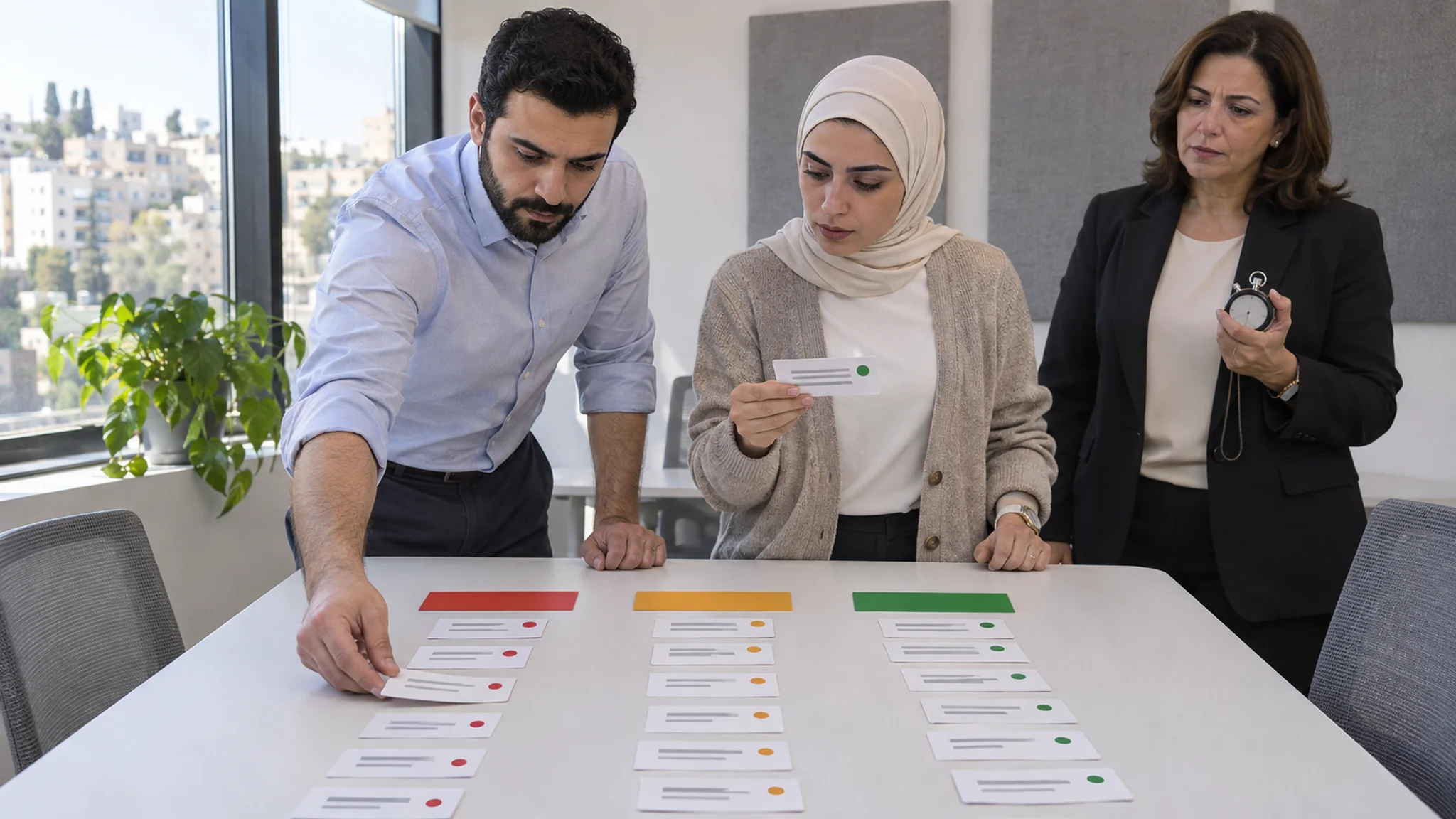
Compare the Training Center Samples Side by SidePut the samples in three columns, one per training center, and compare them on three questions: does the design make participants practice the real task with feedback, does the facilitation language fit how the team works, and is there a credible plan to evaluate application? Write one line of evidence beside each judgment. Include a supervisor who speaks the team’s working languages in the review, because language fit is hard to judge from outside the team. If two training center samples come out close, the teach-back results usually separate them more clearly than the documents do.
Leave logistics to last, but do not ignore them. Whether sessions run at your premises or elsewhere affects practice on your own systems and the time employees spend away from work; our guide to in-company training or an external center in Morocco looks at that choice in detail.
A Hypothetical Example: Inside Sales at a Casablanca Auto-Parts Distributor
The following example is hypothetical and is included only to illustrate the method.
The distributor from the opening sends the same brief to its three shortlisted providers: a sixty-minute module on handling a request for a part that is out of stock, offering an alternative and confirming the order in writing. The first training center returns a polished module in French with a quiz on sales techniques. The second training center returns a module built around three realistic calls, with role-plays in Darija and written confirmations in French, using part names exactly as they appear in the catalog. The third training center sends a short recording of a lively facilitator but no practice activity.
In the teach-back, two of the four employees struggle to explain the first module’s key step, which relies on French sales vocabulary they never use with customers. All four explain the second module’s step clearly. Asked about application, the second training center proposes that supervisors review ten real order confirmations per person after three weeks, using a short checklist in French with notes in Arabic. The HR manager shortlists the second provider and asks the first training center to revise its practice activity before deciding.
SummaryChoosing a corporate training center in Casablanca from brochures leaves the most important questions unanswered. Ask every shortlisted provider for the same sample module, read it as a design, check the language of facilitation against how your team actually works, and ask exactly how application at work will be evaluated.
Treat every language point as a condition to verify with your own employees, not a general rule. The training program you choose will then be one your team can follow, practice, and use, with a corporate training provider that can show the results after the sessions end.
Click here. If you are comparing providers for a team in Casablanca and would like to talk through sample modules, facilitation language, or how to evaluate application, the SkillUp MENA team can discuss your corporate training requirements with you.