
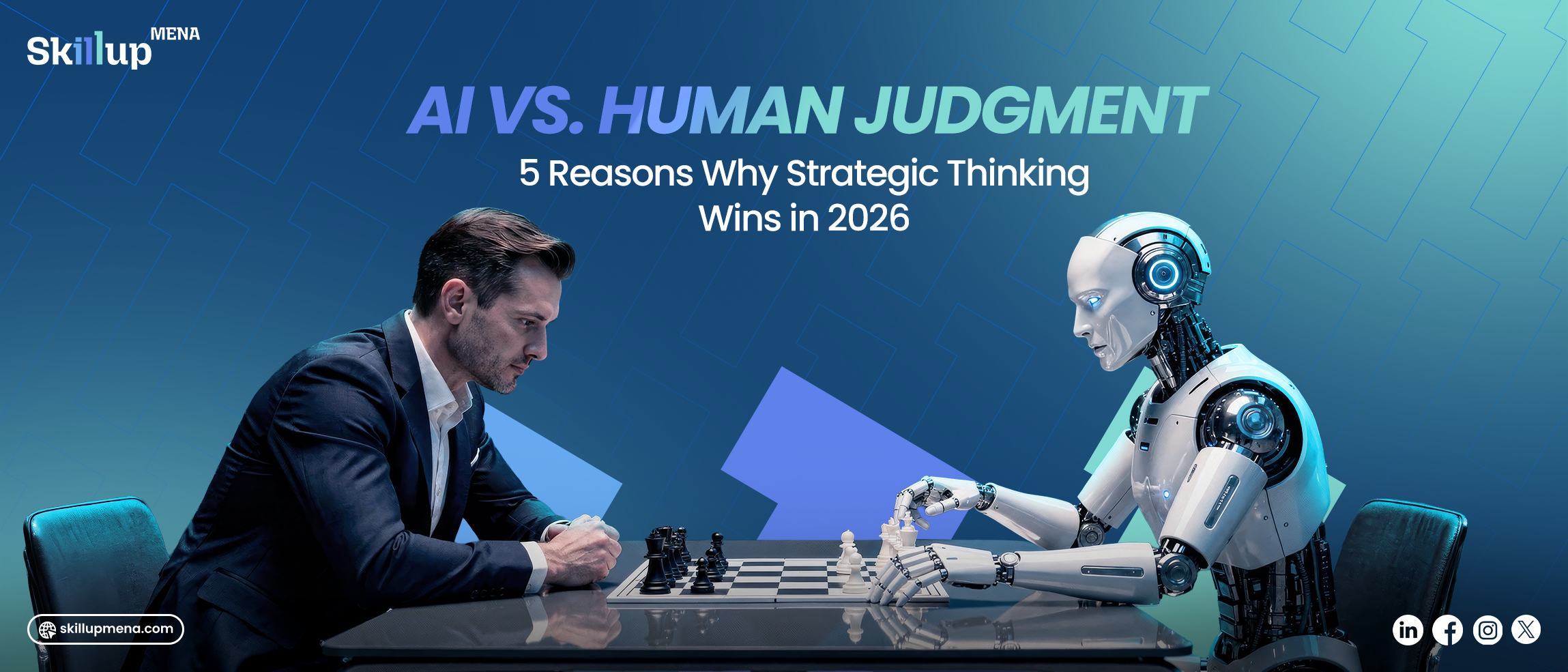
As artificial intelligence accelerates across every sector, a quiet but critical shift is taking place inside organizations. While AI is getting faster, more accurate, and more scalable, human judgment is becoming rarer and more valuable than ever before.
In 2026, the competitive advantage will not belong to organizations that automate the most tasks. It will belong to those that develop leaders and employees who know when to trust AI, when to challenge it, and when to override it.
1. The Automation Paradox: The Rise of the Cognitive Gap
AI has dramatically improved efficiency in data analysis, forecasting, and content generation. Yet, as automation increases, many organizations are discovering an uncomfortable truth: When systems think for people, people gradually stop thinking critically.
This has created a new capability gap—not a technical one, but a cognitive and ethical one. Organizations are now struggling with:
- Algorithmic Over-reliance: Trusting recommendations without verification.
- Decision Atrophy: A reduction in critical questioning.
- The “Black Box” Problem: Leaders unable to explain why a decision was made.
AI can process information, but only humans can exercise judgment.
2. Judgment is a Trainable Capability, Not Just “Instinct”
Human judgment is often misunderstood as mere intuition. In reality, it is a structured, high-level capability that can be developed and measured. In an AI-enabled environment, judgment acts as the final “gatekeeper” for:
- Contextual Awareness: Understanding nuances AI might miss.
- Ethical Reasoning: Navigating “gray areas” where there is no clear data-driven answer.
- Systems Thinking: Seeing the long-term ripple effects of a decision.
In 2026, judgment is no longer a “soft skill”—it is the core leadership capability that determines which risks are acceptable and which data truly matters.
3. Leadership in 2026: The Burden of Decision Accountability
As AI becomes embedded in workflows, accountability risks becoming blurred. It is increasingly tempting for leaders to say, “The algorithm flagged it” or “The system recommended it.”
However, accountability cannot be automated. Future-ready leaders must be able to:
- Interrogate AI outputs for bias or limitations.
- Make high-stakes “calls” with confidence, even when data is conflicting.
- Transparently explain decisions to stakeholders and regulators.
Organizations that fail to develop this accountability will face rapid trust erosion from employees and customers alike.
4. The Learning Shift: From Knowledge to Decision Mastery
Traditional learning models focus on knowledge acquisition and tool proficiency. While necessary, these are no longer sufficient. In 2026, learning must intentionally develop Judgment Mastery through:
- Scenario-based Simulations: Practicing critical thinking under high uncertainty.
- Ethical Trade-off Labs: Navigating complex dilemmas where AI provides no clear path.
- Human-AI Collaboration Skills: Learning the specific art of “Human-in-the-loop” oversight.
Judgment cannot be downloaded; it must be practiced, challenged, and refined in safe, governed environments.
5. Human-Centered by Design: Winning the AI Era
The most advanced organizations are not replacing humans with AI; they are redesigning work so that AI supports humans and humans govern AI. These organizations:
- Define clear “Human Decision Points” in every automated workflow.
- Invest in leadership development that prioritizes emotional intelligence and ethics.
- Measure not only performance speed but Decision Quality.
By doing so, they future-proof their workforce—not against technology, but against poor judgment in high-stakes environments.
Know More about : Elevate Training With Skillup Mena Instructor-led Training – Skillup Mena
SkillUp MENA’s Role: Designing Your Human Edge
SkillUp MENA is a regional leader in capability transformation. We specialize in designing governed, technology-enabled learning ecosystems that integrate:
- Leadership Judgment Programs: Focused on high-stakes decision-making and ethical reasoning in an AI-first world.
- Critical Thinking Frameworks: Tools that help employees interrogate AI outputs and identify algorithmic bias.
- Human-AI Collaboration Mastery: Training teams to use AI as a co-pilot while maintaining cognitive agency.
- Measurable Impact Dashboards: Tracking decision quality and capability growth alongside traditional ROI.
Choosing the right provider is the difference between a wasted budget and a future-proofed workforce. By moving from a “buyer” to a “strategist,” you ensure your L&D function becomes a growth engine.
Ready to see what a true strategic partnership looks like?
SkillUp MENA’s L&D Audit & Consultation provides you with a clear gap analysis of your current strategy and a roadmap for building a world-class, human-centered ecosystem.