Loading...
Subscribe to Our Newsletter
Get the latest updates delivered straight to your inbox.

The ultimate L&D solution for upskilling your workforce.


© 2026 SkillUp MENA, Inc. All rights reserved
Subscribe to Our Newsletter
Get the latest updates delivered straight to your inbox.
The ultimate L&D solution for upskilling your workforce.
© 2026 SkillUp MENA, Inc. All rights reserved

 Share :


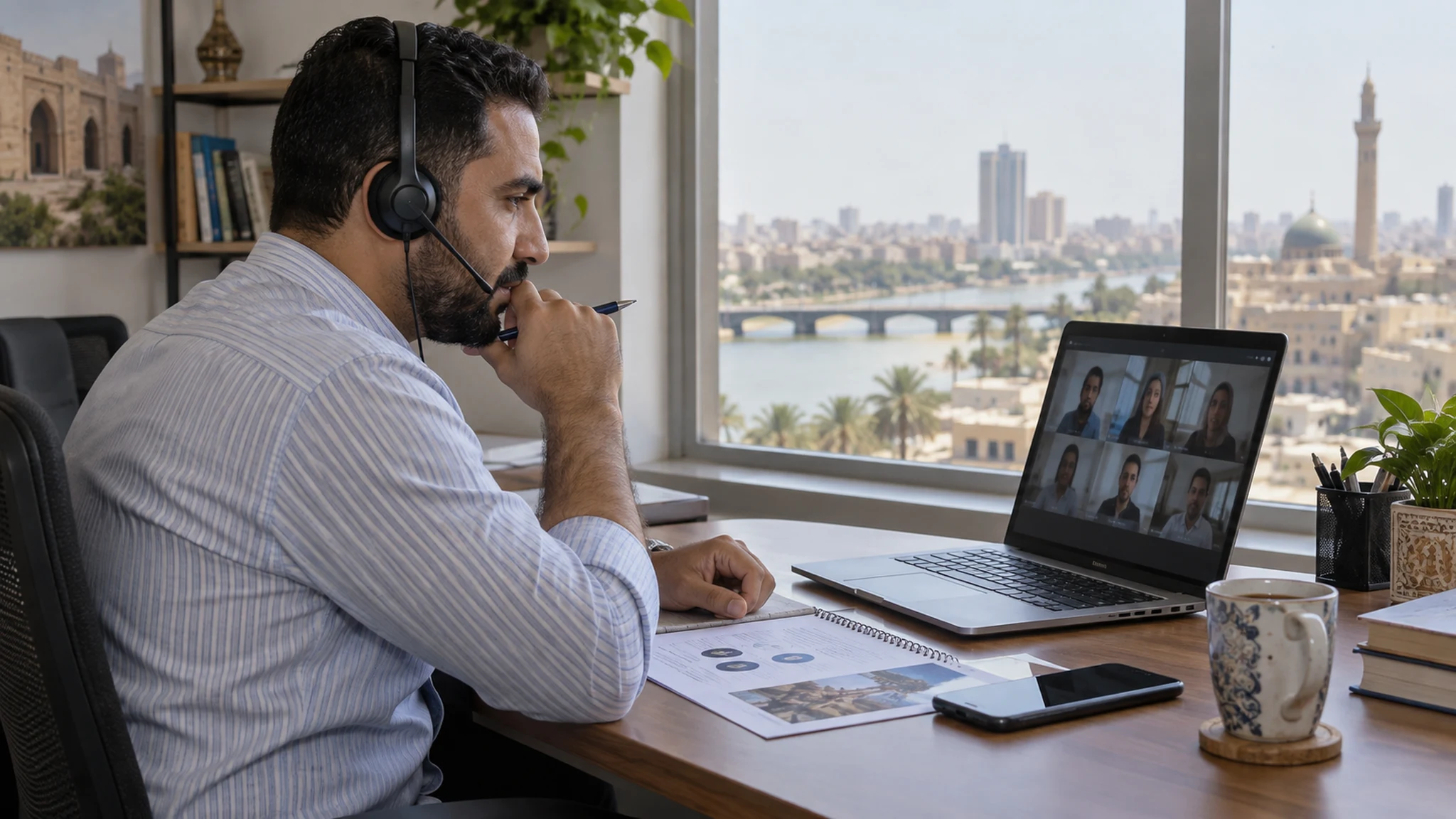
Start with what learners can access Successful VILT in Iraq—virtual instructor-led training—depends on more than a meeting platform. One employee may join from a well-equipped Baghdad office while another relies on a phone and a variable connection. A design that requires everyone to use video, share screens and download large files simultaneously can exclude people before meaningful practice begins.
Run a short audience check covering devices, connectivity, language, working environment and available time. Ask whether employees can use audio or open a document while connected. Design for the locations you are serving rather than treating connectivity across Iraq as uniform.
Distribute the materials before the invitations Reserve live time for activities that benefit from a trainer: interpreting a decision, discussing a case, practising a conversation or correcting an attempt. Send definitions, instructions and the essential reference material beforehand in a small downloadable pack. Understanding the exercise should not depend entirely on a successful screen share.
Give the pack a clear structure: one objective, a short case, activity instructions, a response template and a support contact. Use consistent file names and version labels so participants and facilitators work from the same material. Avoid distributing competing versions through different channels.
Build fallbacks around the learning objective Give each activity a primary route and an appropriate alternative:
If video fails, switch to audio and previously downloaded materials where these support the required participation.
If screen sharing fails, use clear page references and describe the relevant step aloud.
If breakout rooms fail, use individual preparation followed by a sample discussion in the main room.
If connectivity is lost completely, specify a make-up task and a review appointment or alternative session.
If assessment requires direct observation, reschedule it rather than treating a recording as equivalent evidence.
Audio alone will not suit every learner, and text alone will not meet every accessibility need. W3C guidance on remote meetings treats accessibility as a combination of platform, content and meeting practices. Test alternatives with participants, provide usable materials and arrange captions where needed.
Agree on a rejoining protocol Explain what participants should do after a disconnection: how to return, where to find instructions, how to submit work and whom to contact. Where group size justifies it, assign a support coordinator to manage access problems while the trainer concentrates on learning.
Avoid using an active camera as a universal participation test. Ask for evidence that suits the objective: an explanation, a case response or a demonstrated step. Where observation is essential, explain the requirement beforehand and check that the equipment and environment support it.
Measure access and proficiency separately Track successful access, connection problems, interrupted activities and completion through alternative routes. Then assess capability using a shared task or an equivalent task with the same scoring criteria. Compare results by location and device without assuming that a weak connection indicates weak skills.
Follow the session with a workplace assignment and a short manager review. If employees do not apply the skill, establish whether they had an opportunity and the authority to do so before judging the training.
Pilot before expanding Choose one role and two locations with different access conditions. Test downloading, joining and audio before running a session that includes a decision, practice and feedback. Review disruption patterns, response quality and the follow-up assignment, then improve the design.
VILT in Iraq becomes more resilient when continuity is built into the programme. Employees should retain a meaningful opportunity to learn and demonstrate capability even when their route into the session changes.
Next step: Contact SkillUp MENA to design live virtual training that fits your teams’ locations and devices, combining flexible access with measurable practice.