Loading...
Subscribe to Our Newsletter
Get the latest updates delivered straight to your inbox.

The ultimate L&D solution for upskilling your workforce.


© 2026 SkillUp MENA, Inc. All rights reserved
Subscribe to Our Newsletter
Get the latest updates delivered straight to your inbox.
The ultimate L&D solution for upskilling your workforce.
© 2026 SkillUp MENA, Inc. All rights reserved

 Share :


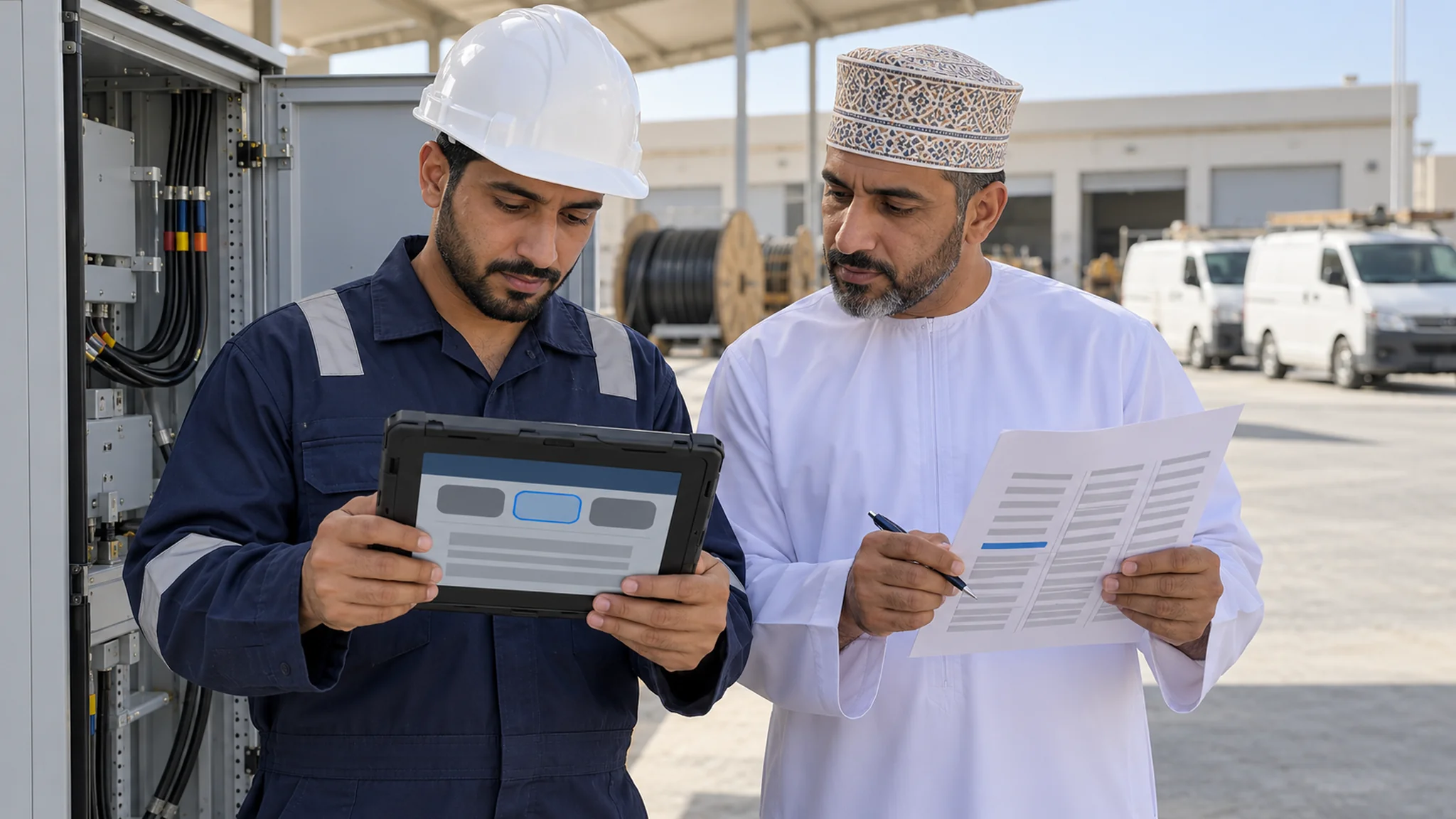
Translating Training Content in Oman: Aligning System and Workplace TerminologyA new technician in Muscat opens the Arabic guide for the company’s work-order app. Step 6 tells him to press the ‘close’ button. On his tablet, the button reads ‘Complete ’ in English. His supervisor uses a third word that appears nowhere in the guide or the app. The translation was accurate. The training still failed because it named one action three different ways.
This is the most common gap in translated training content: the words on the system screen, the words in the training material, and the words the team uses on site drift apart. Translation services usually receive a document to translate, not the screens and the site, so the gap is built in before anyone notices it.
This article is for HR and digital learning teams in Omani organizations that commission translation services for training content. It covers four practical steps: a glossary that connects the three vocabularies, a better brief for translation services, an equivalence check between the explanation and the tool, and a review with the people who do the work.
Why Translated Training Breaks at the ScreenSystem-based training uses three vocabularies at once. Screen terms are the labels, buttons, and messages employees see, in whatever language the system runs. Document terms are the words used in procedures and in the training itself. Workplace terms are what supervisors and colleagues actually say. If your systems run in English while teams talk about the work in Arabic, or if the system has its own Arabic interface written by the vendor, the three can easily differ, and translation services working from a document alone will not see it.
The W3C describes localization as the adaptation of content to meet the language, cultural, and other requirements of a specific target market, including date and number formats, currency and symbols. Training content is no exception. Good translation services can render a sentence accurately; only your organization can tell them which word the screen uses and which word the site uses.
Build a Three-Column Glossary Before Translation Services BeginStart with the concepts employees must recognize to do the task, and finish the list before you brief translation services: buttons, fields, statuses, messages, documents, and equipment parts. For each concept, record:
The rule column is what makes the glossary useful. A common rule for system training is simple: never translate a screen label that employees will see untranslated. Quote it exactly, then explain it in the training language. Where the system has an Arabic interface, use its Arabic labels word for word, even if translation services would suggest a smoother phrase.
Consistency matters as much as accuracy. The U.S. government’s plain language guidance warns that using different terms for the same concept or object can confuse readers, because a new term makes them wonder whether you mean the same thing. In translated training, that confusion costs more: the employee is matching words across two languages and a screen.
Brief Translation Services with Screens, Not Just DocumentsMost errors in translated training content can be traced back to the brief. When you commission translation services, whether an external agency or an in-house language team, send more than the source file:
Ask your translation services provider to keep a query log rather than guessing. Every question about an unclear term, such as whether ‘close’ means the work order or the cabinet door, should come back to the subject-matter expert, and every answer should go into the glossary.
Check, too, that you hold the editable files needed to translate and update the content later. If a vendor built the original course, our guide to source files and updates when buying training content in Oman lists the questions to settle first. Good translation services can only work with what they are given. Before screenshots leave the organization, replace any real customer or employee details with test data.
Questions to Ask When Choosing Translation Services for TrainingNot all translation services are set up for system-based training. Before you commission a provider, ask:
The answers show whether the translation services you are considering will treat your glossary as a working tool or as an attachment that nobody opens.
Check Equivalence Between the Explanation and the ToolOnce translation services return the text, test it against the tool itself. Ask someone who knows the system to follow the translated instructions step by step in the live system or a test environment, with no other help. At every step, check that:
Record every mismatch in a short log, with the step, what the text says, what the screen shows, and the fix. Some fixes belong in the translation; others reveal that the system was updated after the source was written. Share the log with your translation services provider, so the same correction is not needed in the next module.
Review with the People Who Do the WorkEven a text that matches the screen perfectly, from the most careful translation services, can be misunderstood on site. The final check is with employees from the target roles, ideally from more than one site or shift. Digital.gov’s guidance on paraphrase testing suggests a simple method: a participant reads a section and explains it in their own words without being corrected, across 6 to 9 one-on-one sessions. Wherever participants misunderstood the message, the content has a problem to fix.
In each session, ask two extra questions: what would you press next, and what would you call this on site? The first tests the link to the tool; the second tests the link to the workplace. Answers to the second often add a missing workplace term to the glossary. Share the findings with your translation services provider, because the same misunderstanding is likely to appear in the next module.
Keep the Glossary AliveSystems are updated and site vocabulary changes. Give the glossary one owner, review it whenever the system or a procedure changes, and send each update to your translation services provider before the next job. For keeping translated versions in step over time, see our article on managing version updates in training translation projects.
A Hypothetical Example: A Work-Order App at an Omani UtilityThe following example is hypothetical and is included only to illustrate the method.
A utility company with field teams in Muscat and Salalah is moving its maintenance technicians to a new work-order app whose interface runs in English. The training team plans an Arabic guide and short practice tasks, and engages external translation services for the text.
Before translation, the team builds a glossary of 40 concepts, from ‘Assign’ and ‘On hold’ to ‘Isolation confirmed’. The rule for screen labels is to quote them in English, followed by an Arabic explanation; workplace terms collected from supervisors appear once, in brackets. The brief to translation services includes 60 screenshots and a list of untranslatable strings.
The query log from translation services raises nine questions, including whether ‘Complete’ and ‘Close’ are different actions. They are, and the glossary now says so. The walk-through in the test environment finds four mismatches, two caused by a recent app update. In paraphrase sessions, technicians in Salalah use a different word for one status than their Muscat colleagues, so both terms are added. The guide is released only after these fixes, and the glossary goes to translation services for the next module.
SummaryTranslated training works when the training text, the system screen, and the workplace use connected terms. A three-column glossary links them, a brief with screenshots and clear rules lets translation services do accurate work, well-chosen translation services keep that standard from one module to the next, a walk-through checks the explanation against the tool, and paraphrase sessions with employees confirm that the result is understood on site.
Treat the glossary as a living asset that you and your translation services provider update whenever the system or the procedure changes. That routine connects naturally with updating eLearning when work procedures change in Oman, so that every change reaches the screen, the training, and the team in the same words.
Click here. If you are planning to translate training content for teams in Oman and want the result to match both the screens and the site, the SkillUp MENA team can discuss your translation services and content production requirements.