Loading...
Subscribe to Our Newsletter
Get the latest updates delivered straight to your inbox.

The ultimate L&D solution for upskilling your workforce.


© 2026 SkillUp MENA, Inc. All rights reserved
Subscribe to Our Newsletter
Get the latest updates delivered straight to your inbox.
The ultimate L&D solution for upskilling your workforce.
© 2026 SkillUp MENA, Inc. All rights reserved

 Share :


Why does blended learning fit the Saudi market?
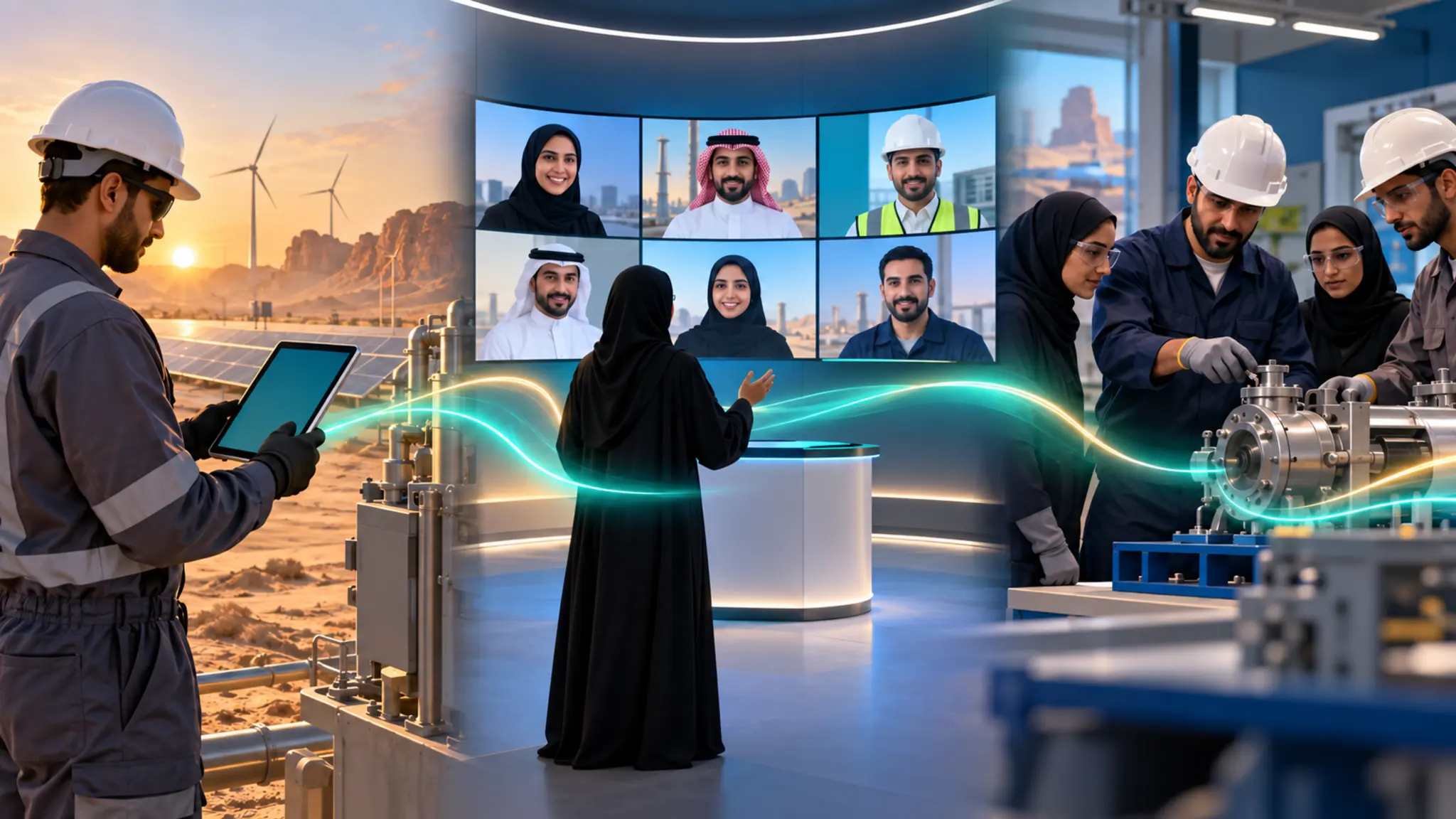
Many Saudi organizations manage teams across cities, branches, projects and operating sites. Their workforces include office-based and frontline employees with different levels of digital access. Instructor-led delivery alone raises reach costs and limits scale. Self-directed learning alone may weaken practice and feedback. A blended model assigns each learning function to the most suitable channel.
Blended Learning in Saudi Arabia therefore means more than adding an online link to an instructor-led course. An effective model creates one journey, defines the function of every channel, manages transitions, activates managers and specifies evidence of proficiency and application.
Saudi Arabia’s National eLearning Center defines blended learning as a combination of conventional learning and distance learning. Its standards cover governance, strategy, design, assessment, support and accessibility. Blending therefore requires integrated objectives, experience, evidence and support rather than technology alone.
Which problem does blending solve?
The need begins with operating reality rather than a desire to use more channels. An audience may be distributed across Riyadh, Jeddah, Dammam and other cities, or between offices, sites, projects and shifts. Gathering everyone at one time can disrupt service or production.
1. Difficulty bringing employees from several locations together at the same time.
2. Lost operating hours, travel and cost when every topic uses instructor-led delivery.
3. Lower self-directed completion when pathways lack rhythm and support.
4. Standardized learning that ignores role, device, language and experience differences.
5. Experiences ending with knowledge rather than workplace practice and manager follow-up.
6. Fragmented data across attendance, virtual classrooms, platforms and projects.
Blended Learning in Saudi Arabia addresses these challenges when design begins with the decision or task that should improve. A blended route may cost less than fully instructor-led delivery, but additional transitions and channels require management. Blending is not automatically easier.
Select channels by learning function
No channel is universally superior. Ask which learning function a stage needs. Explanation may fit a short module, while negotiation practice or a safety procedure may require facilitated observation and feedback.
1. Self-directed content: foundational concepts, preparation, review and reference at the point of need.
2. Virtual classroom: discussion across locations, questions, analysis and guided practice.
3. Instructor-led session: physical skills, intensive observation or highly sensitive interaction.
4. Workplace application: authentic evidence produced under manager or expert supervision.
5. Community of practice: shared cases and exceptions that reinforce behaviour after the programme.
6. Performance support: a checklist, short video or prompt available during execution.
Blended Learning in Saudi Arabia becomes more efficient when the organization avoids repeating the same function in every channel. Learners do not need a recorded lecture followed by the same lecture in a classroom. The first channel should establish a foundation, while the next uses time for analysis, practice and feedback.
One journey rather than adjacent parts
Before a session, learners complete a short diagnostic and foundational concept so the group begins from a known point. During virtual or physical sessions, time focuses on cases, practice and feedback. Learners then perform a workplace task, managers review the evidence and a follow-up community or session examines application. Every stage prepares for the next.
When self-directed content never appears in the session, or the session has no connection with the task, the experience is a collection of channels rather than a truly blended pathway. Objectives, language, assessment, identity and data need consistency across the journey.
1. Preparation: a short diagnostic, foundational concept and clear access instructions.
2. Facilitated practice: a case, simulation or discussion producing an observable decision or performance.
3. Application: an authentic task completed within the learner’s role.
4. Reinforcement: manager or expert feedback and a reference available at the point of need.
5. Follow-up: evidence review, barrier discussion and a decision to improve or scale.
This structure gives Blended Learning in Saudi Arabia a visible rhythm and clear accountability. Learners and managers can understand expectations at each stage rather than chase unrelated links and dates.
Design for distributed audiences from the beginning
Job title alone cannot define audience needs. Gather information about role, location, shift, device, language, connectivity and experience. A frontline employee may need downloadable resources and access through a shared device, while an office employee may join a virtual classroom through dedicated equipment.
Choose the minimum accessible experience before adding advanced features. Keep files lightweight, provide simple instructions, test entry before the session and define an alternative when connectivity fails. Learning time should also appear in operating schedules so the programme does not become unpaid personal work after normal hours.
With this foundation, Blended Learning in Saudi Arabia begins with real user conditions rather than assumptions made by the design team.
This approach helps Blended Learning in Saudi Arabia reach branches and sites without assuming equal conditions. Equity does not require one channel for everyone. Equity requires practical alternatives that lead toward the same proficiency standard.
Localization within Saudi Arabia
The Human Capability Development Program under Saudi Vision 2030 places citizen capability, lifelong learning and labour-market alignment at the centre of transformation. Responsible alignment explains which skill, role and enterprise outcome a programme supports rather than using the Vision as a substitute for measurement.
1. Use Saudi cases, decisions and work environments rather than relying on translated global examples alone.
2. Design in Arabic from the beginning and add English terminology where professional practice requires one.
3. Consider cities, locations, shifts, connection speeds, devices and data policies.
4. Provide suitable access alternatives and apply accessibility and technical and learning-support requirements.
5. Connect capability with work priorities and the Human Capability Development Program without claiming that one initiative achieves a national target.
6. Prepare managers and facilitators to manage interaction and application rather than operate technology alone.
Localizing Blended Learning in Saudi Arabia also means testing language, examples and timing with real users. A linguistically accurate translation may still differ from terminology used at the site or in the service. Design needs workplace experts and audience representatives.
Blended Learning in Saudi Arabia also needs assessment suited to role context rather than one generic test for every audience.
The manager’s role in learning transfer
Learners can complete every stage without using the capability when managers provide no task, time or authority. Managers should understand the pathway goal, expected behaviour, required assignment, observation standard and the question to discuss with the employee.
Managers do not need a heavy administrative programme. A short pre-pathway guide, one post-session conversation and an application-task review may be enough for the starting point. When managers identify a system or process barrier, the organization should record and resolve the issue rather than label the problem as learning resistance.
This role raises the value of Blended Learning in Saudi Arabia because learning channels become connected to the work environment. Manager evidence also helps L&D distinguish weak proficiency from missing application opportunity.
Governance and operations
One person or team should own the complete journey even when several teams or suppliers manage different components. Responsibilities, handovers and data movements between stages need explicit definition.
1. Define the journey owner, capability owner, channel responsibilities and handover points.
2. Set standards for content, assessment, attendance, recording, data protection and accessibility.
3. Maintain one core version with localization modules for roles and sites rather than conflicting copies.
4. Provide support before, during and after sessions, with a clear route for device or access problems.
5. Review evidence every week during the pilot to correct reach and rhythm before the programme ends.
Governance prevents Blended Learning in Saudi Arabia from becoming separate initiatives with different definitions of completion and success. A simple data dictionary should define active learner, stage completion, success, accepted task and measurement period.
Technology should serve the design
The journey may need a learning platform, virtual classroom, assessment tool, reminders and dashboard. Purchasing technology before defining the learner journey can produce fragmentation. Begin with tasks and flows, then select the smallest tool set that enables access, evidence and support.
Test sign-in through the real device, identity integration, data protection, downloads, Arabic support and the team’s ability to update the pathway. A backup route should exist when a tool fails because learning continuity should not depend on one channel.
This testing protects Blended Learning in Saudi Arabia from technical problems that may appear differently across cities and sites.
With this priority, Blended Learning in Saudi Arabia uses technology to simplify experience rather than force learners through systems that add no learning value.
What do success stories demonstrate?
SkillUp MENA’s internal Al Ayuni case documents 94.5% platform activation, 119,655 registrations, more than 39,826 learning hours and 77.9% completion within a mobile-first, bilingual and role-based experience. The internal MEMF case records 86% adoption, 268 active journeys and 90% average completion.
The figures come from two different internal cases. Client names and internal data require approval from SkillUp MENA and each client before publication. The figures demonstrate activation, reach and engagement under the case definitions, but cannot independently prove commercial impact or sustained performance change.
The professional achievement lies in operating structured experiences at scale across industrial and distributed environments. Mature Blended Learning in Saudi Arabia goes beyond activation by adding skills assessment, workplace application, a close performance measure and a clear explanation of each channel’s contribution.
A channel and outcome dashboard
Measurement should follow the complete journey rather than average completion alone. Reach may be strong in an office and weak at a frontline site. Learners may complete content without moving to application.
Blended Learning in Saudi Arabia should therefore measure transitions between stages as carefully as outcomes within each stage.
1. Reach by location, role and device rather than an overall average alone.
2. Transition between preparation, session, task and follow-up stages.
3. Proficiency through an appropriate assessment before and after the pathway.
4. Facilitation, interaction and support quality, including technical issues and resolution speed.
5. Workplace behaviour application and manager or expert feedback.
6. A close work measure with a baseline and transparency about other factors.
Also compare cost per reached learner, time away from work and time to readiness. The lowest-cost channel does not necessarily create the highest value. Self-directed content may reduce distribution cost while still needing facilitation and follow-up for application. This balance improves Blended Learning in Saudi Arabia through evidence.
Common design mistakes
1. Recording a long classroom course and treating the recording as suitable self-directed learning.
2. Repeating the same content in the module, virtual classroom and physical session.
3. Using instructor time for explanation that could happen beforehand and leaving no time for practice.
4. Ignoring managers and workplace assignments after the session.
5. Launching without testing connectivity, devices and support with the real audience.
6. Collecting channel data without a consistent learner identifier or stage definition.
Avoiding these mistakes makes Blended Learning in Saudi Arabia more connected and prevents complexity without value. The standard is not channel count, but each channel’s contribution to movement from knowledge to performance.
When every channel shows a clear contribution, Blended Learning in Saudi Arabia becomes easier to improve and scale with confidence.
A 12-week pilot
Blended learning is not a compromise between physical and digital delivery. The model assigns every channel to a suitable function and helps a distributed workforce build demonstrable capability.
1. Weeks 1–2: select one capability and an audience across at least 2 locations, then define the baseline and barriers.
2. Weeks 3–5: design 4 moments covering self-directed preparation, facilitated practice, a workplace task and follow-up.
3. Week 6: test access, technology and content with a small sample, and prepare managers and facilitators.
4. Weeks 7–10: run the pilot and review transition and support evidence each week.
5. Weeks 11–12: compare proficiency, application, cost and location experience, then improve before scaling.
The pilot allows an organization to test Blended Learning in Saudi Arabia within its own operating reality rather than copy a generic model. Document differences between sites, the value of each channel and required localization so expansion transfers a learned model rather than merely adding participants.
The evidence also helps leaders position Blended Learning in Saudi Arabia within workforce and capability priorities rather than as a standalone technology initiative.
The practical conclusion
Blended Learning in Saudi Arabia succeeds when the organization creates one journey with a goal, capability and evidence, selects channels by function, designs for access, activates managers and unifies data and governance. Blending then becomes more than a technology choice or cost measure. The model helps distributed workforces learn, practise and apply capability.
Frequently asked questions
Is blended learning always less expensive?
No. Blending may reduce travel and time away from work but requires design, technology, support and facilitation. Compare cost with value and outcomes.
How many channels should a pathway include?
Use the smallest number that achieves the objective, practice and access requirements. More channels do not prove better blending.
What is the most important element after a session?
A clear application task, an opportunity enabled by the manager, an accepted evidence standard and feedback at a known time.
These elements allow Blended Learning in Saudi Arabia to continue beyond the final scheduled session.
They also connect Blended Learning in Saudi Arabia with real performance after facilitated learning ends.
NEXT STEP
Contact SkillUp MENA to design a blended learning model suited to your audience and operating context in Saudi Arabia.
-------------------